
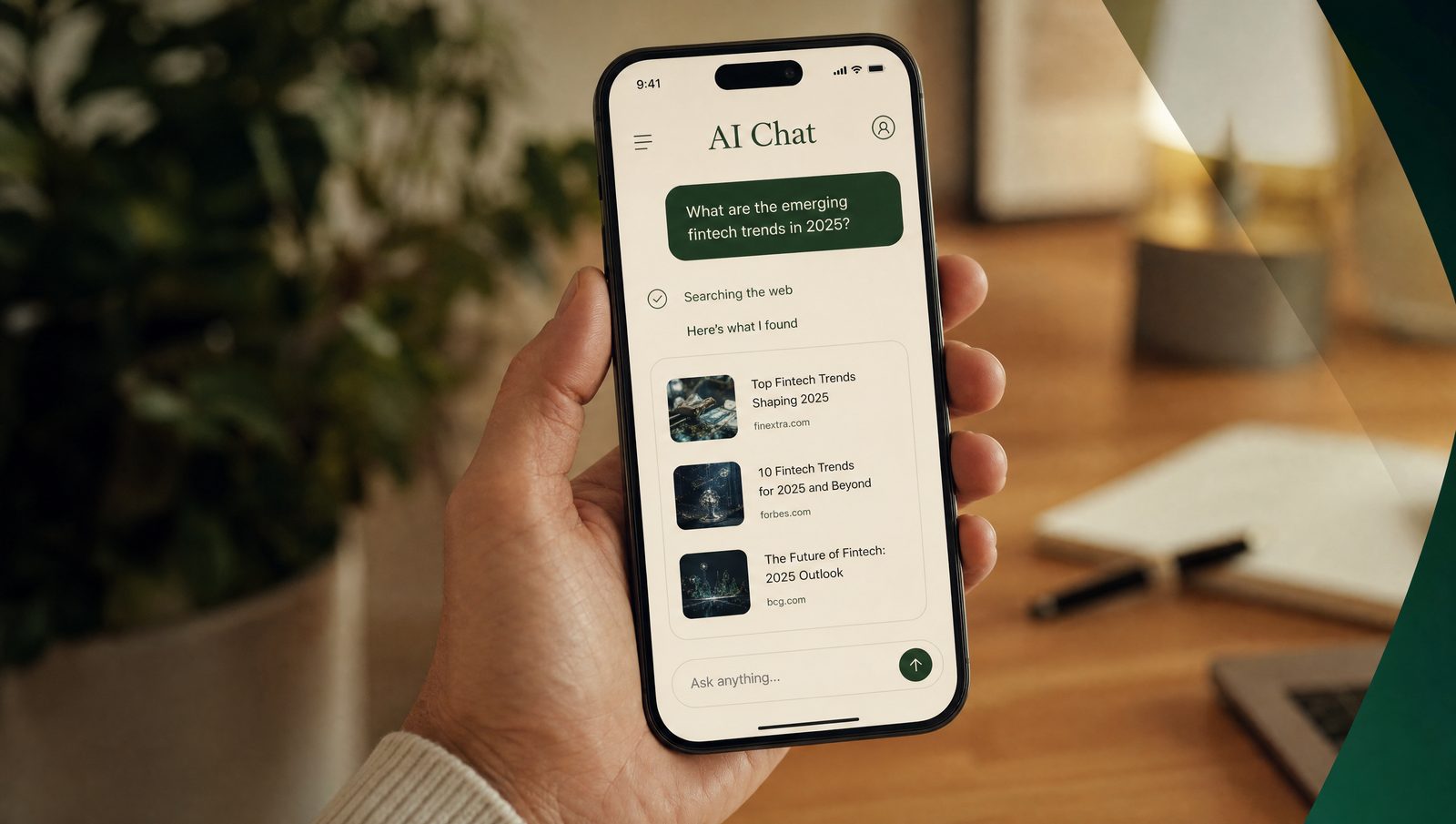
Something quietly significant has happened to the way people find businesses online, and most business owners we speak with have not yet adjusted to it. The Google search box, for two decades the centre of gravity for online discovery, is no longer the only door customers walk through. A growing share of buying decisions now starts inside ChatGPT, Claude, Perplexity, Google AI Overviews, and Bing Copilot. If your website is not discoverable inside those tools, you are invisible to a fast-growing portion of your potential customers, and at Ummah Design we think this deserves to be treated as a now-issue, not a future one.
We call this discipline AI search optimization, or Generative Engine Optimization (GEO). It is not a replacement for traditional SEO. It is an extension of it, and in some ways it rewires the priorities. The businesses that move first will own this real estate before competitors realise it exists.
The shift nobody told your business about
Five years ago, a customer looking for a halal restaurant in Birmingham would type "best halal restaurant Birmingham" into Google, scroll past the ads, and click somewhere in the top three organic results. Today, that same customer is increasingly likely to open ChatGPT and ask: "Give me five highly-rated halal restaurants in Birmingham with outdoor seating, and tell me which one is best for a family with young kids."
Notice the difference. The query is longer, more specific, conversational, and the user expects a synthesised answer, not a list of blue links. They will read the AI's summary, accept its recommendations, and in many cases never visit Google at all. The "winner" of that query is not whoever ranked first on a search results page. The winner is whichever business the AI quoted, named, or recommended in its answer.
That is a fundamentally different game, and it has fundamentally different rules.
Google ranking is no longer the only goal
Traditional SEO still matters, because AI search engines lean heavily on the open web as their training and retrieval corpus. But ranking on page one of Google is no longer sufficient. The new goal is to be the source the AI quotes from. To be quoted, your content has to be structured in a way the AI can lift cleanly into its answer.
We have started auditing client sites with a slightly different question in mind. Not "would Google rank this?" but "if ChatGPT were asked about this topic, would our page be useful enough for it to cite us?" Those two questions overlap a lot, but they are not the same question, and the divergence is where the opportunity is.
How AI search engines pick their sources
The major AI search systems are not magic. They follow a fairly consistent pattern when deciding which sources to surface in an answer. From what we have observed across client projects and our own experiments, they reward:
- Clean, fast, well-structured HTML. Semantic tags, proper heading hierarchy, no JavaScript-rendered walls of text. If a crawler cannot parse your page in plain HTML, it will not quote you.
- Clear factual content. Definitions, lists, comparison tables, direct statements. Marketing fluff gets ignored. Concrete facts get lifted.
- Schema.org structured data. JSON-LD for Organization, LocalBusiness, Product, FAQ, Article, and Review. This is how the AI knows what kind of thing your page is about.
- Crawler accessibility. Your
robots.txtneeds to allow GPTBot, ClaudeBot, PerplexityBot, Google-Extended, and Bingbot, unless you have a deliberate reason to block them. A surprising number of sites block these by default and have no idea they are doing it. - Trustworthy citations and external mentions. Being referenced on third-party sites, forums, directories, podcasts, and news pieces gives the AI confidence you exist and matter.
- Up-to-date facts. Stale prices, outdated opening hours, dead phone numbers, removed staff. AI engines deprioritise content that looks abandoned.
New ranking signals nobody is optimising for yet
Here is the part that excites us, because it is where the early-mover advantage lives. Several signals are emerging that almost no business is currently optimising for:
- Brand mentions across the open web. Reddit threads, niche forum posts, podcast transcripts, Substack newsletters, YouTube descriptions. AI engines triangulate trust by counting how often a brand is referenced in conversational contexts, not just in backlinks. A handful of Reddit mentions can outweigh a dozen low-quality backlinks.
- Direct factual statements rather than fluffy marketing prose. Sentences like "Our halal-certified butchery in Leicester has supplied seventeen mosques since 2012" are gold. Sentences like "We are passionate about quality and committed to excellence" are noise. AI engines cannot lift the second one. They can absolutely lift the first.
- Q&A-style content. AI loves to extract question-and-answer pairs. FAQ pages, knowledge base entries, and pages structured as "Common questions about X" perform disproportionately well.
- llms.txt files. An emerging standard, similar in spirit to
robots.txt, that gives AI crawlers a curated map of the most important pages on your site. It is not yet universal, but adoption is moving fast, and the cost of adding one is essentially zero.
What we recommend you do this quarter
If you take only one thing from this post, take this: AI search optimization is not a six-month strategy project. There are a handful of concrete moves you can make in the next two weeks that will materially change how visible your business is inside AI tools.
- Audit your robots.txt today. Make sure you are not unintentionally blocking GPTBot, ClaudeBot, PerplexityBot, or Google-Extended. We see this misconfigured constantly.
- Add comprehensive schema markup. At minimum: Organization, LocalBusiness (with address, opening hours, geo coordinates), Product or Service, FAQ, and Review. Use JSON-LD, not microdata.
- Restructure your content into citable passages. Break long paragraphs into shorter, self-contained statements. Add subheadings. Use bullet lists for any content that is enumerable. Imagine an AI lifting one paragraph out of context, and write so that paragraph still makes sense on its own.
- Build factual reference pages. A genuinely detailed services page, a proper FAQ, an about page with real history and real numbers, a location page with verified contact data. These are the pages AI engines reach for first.
- Get mentioned on third-party sites in your niche. Guest posts, podcast appearances, directory listings, community forums. The goal is to exist as a referenced entity, not just as a website.
- Publish an llms.txt file. A short, plain-text index of your most important URLs at
/llms.txt. It is easy to add and starts to matter more every month.
A note on Muslim and halal queries
This is the part we want our community to hear clearly. AI engines often get Muslim, halal, and Islamic queries wrong, because there is comparatively little authoritative, well-structured content on the open web that they can pull from. We have seen ChatGPT recommend non-halal restaurants in answer to halal queries, misattribute scholarly opinions, and confuse certification bodies.
That is not a problem. That is an opportunity. The Muslim businesses, charities, scholars, and ethical brands that publish clear, factual, well-structured content right now will become the default sources these AI systems quote from for the next decade. The space is wide open. There is no incumbent. Whoever shows up with rigour wins.
If you would rather have this done than read about it, AI-search readiness is now part of every engagement at our Muslim SEO agency: the same pages that rank on Google are structured so ChatGPT and Claude can cite them too.
This is not optional anymore
We are not writing this post because AI search is a trend to keep an eye on. We are writing it because the shift has already happened, and most businesses we audit are losing visibility without realising it. Traffic that used to arrive via Google is being intercepted at the AI layer, and the businesses appearing in those AI answers are not necessarily the ones with the biggest budgets. They are the ones who structured their content for machines to read, while their competitors were still tweaking meta descriptions.
Move now, while the rest of your industry is still asleep on this. The cost of acting early is small. The cost of acting late is being invisible in the channel your customers are quietly migrating to.
If you would like us to audit your site for AI search readiness, we are taking on a limited number of GEO audits this quarter for Muslim businesses, charities, and ethical brands. Get in touch with us at Ummah Design and we will tell you, honestly, where you stand and what to do next.
Ready to put this into practice? Explore our AI automation service for Muslim businesses or book a discovery call — we build custom automations using Make, Claude AI and OpenAI.