
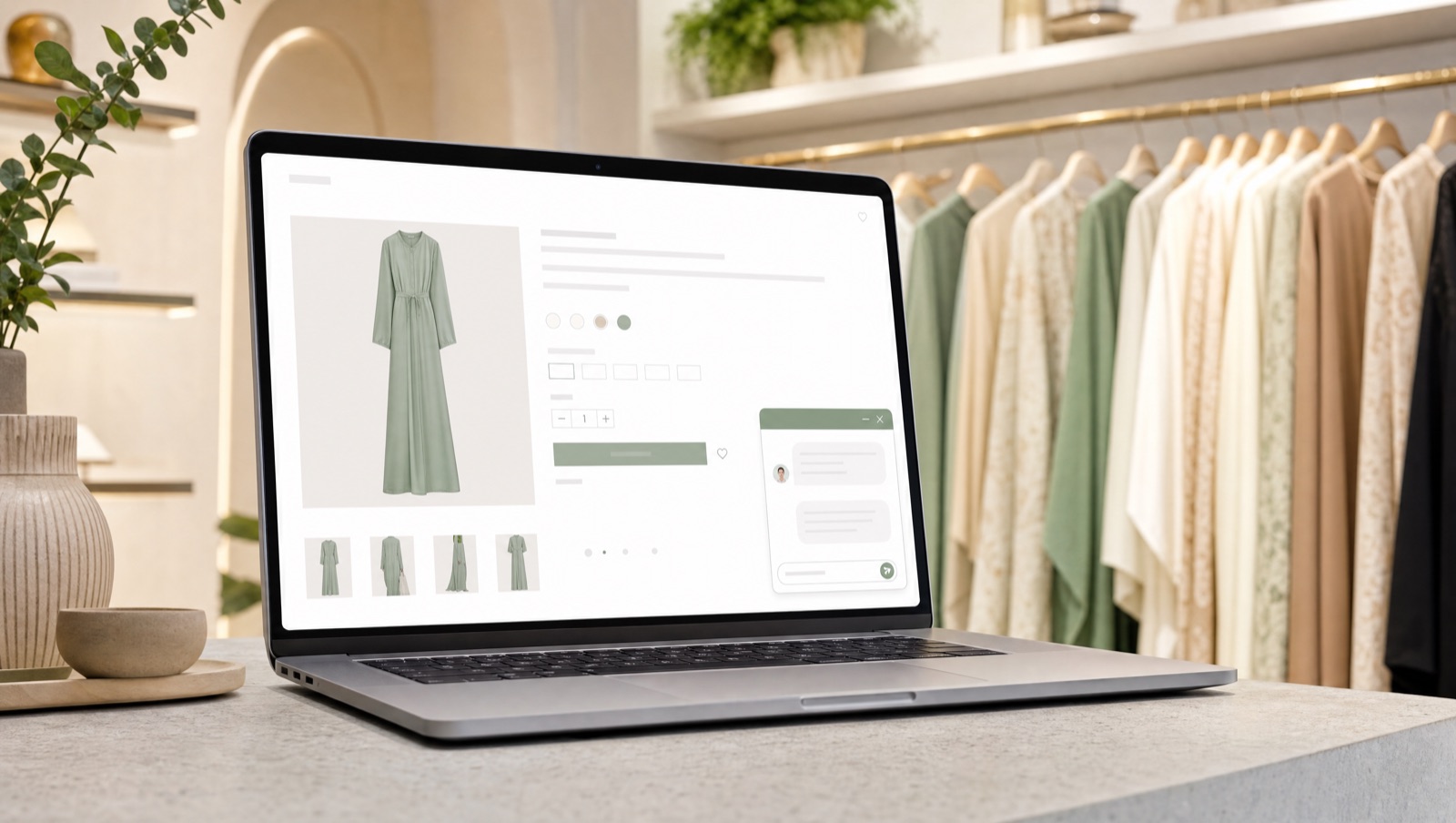
Walk into a good boutique and someone greets you, asks what the occasion is, finds your size, and gently mentions that the hijab on the far rail matches. Walk into the same brand's website and you get… a search bar. The gap between those two experiences is what AI shopping assistants exist to close — and 2026 is the first year we can say, from building and running them on live stores at Ummah Design, that they genuinely do. Here is an honest account of what they can and cannot do.
What a good assistant actually does
Discovery by conversation. "I need something elegant for a nikkah in June, size 54, under $150, not black" is an impossible search query and a trivial sentence. A well-built assistant reads the intent — occasion, size, budget, colour — and answers with actual products from live inventory, the way a good shop assistant would.
Sizing guidance. The single most common pre-purchase doubt in modest fashion. An assistant that knows your size philosophy can talk a customer from "I'm usually a medium but I like it loose" to a confident choice — and knowing its limits, point to the product page's chart for the final word. Fewer abandoned decisions; fewer double-shipped exchanges.
The service questions. Where is my order, what is the returns window, do you ship to Riyadh, is this restocking — the repetitive 80% of support, answered instantly at any hour, exactly as we described for Instagram DMs, but on the store itself.
The polite extra sale. "The chiffon hijab in sand pairs beautifully with this" — cross-sell as service rather than push, which is the only kind that works in this niche.
What it cannot do (and should not pretend to)
An assistant cannot rescue a store with poor product photos, missing size data or vague descriptions — it can only converse about information that exists. It should not bluff: the correct answer to an off-catalogue question is a graceful handover to a human, not improvisation. And it will not replace your customer-service person; it replaces the eleven-o'clock-at-night portion of their job, which is the portion nobody was doing anyway.
The guardrails that separate serious from gimmick
If you evaluate any assistant — ours included — insist on these. It speaks only about your catalogue, never invents products, prices or promises. It stays within your brand's tone and your community's values. It hands over to humans cleanly. And every product it recommends carries tracking, so its influence shows up in the order data, not in a vendor's slideshow. Which brings us to the question that matters more than any feature list.
The only honest measure: attributed revenue
"Engagement" is what assistant vendors show you when they cannot show you sales. The serious measure is simple: did customers who talked to the assistant buy — and can you trace those orders? The gold standard is a holdout test: show the assistant to most visitors, hide it from a control group, compare. That is how we run ours, because a store should never have to take an AI's usefulness on faith — the philosophy behind everything in our complete automation guide.
Is your store ready for one?
Good candidates: a catalogue too big to browse casually, recurring sizing questions (problem 10 on the checklist), international traffic across time zones, and DMs full of questions the website should be answering. If that sounds like your store, an assistant is no longer futuristic — it is a shop assistant who never sleeps, costs less than a Saturday employee, and reports her sales honestly. Ours is one of the nine engines on the service page, live demo included.