Donor emails are the messages that keep a supporter close between gifts: a welcome after their first donation, a regular update on what the money is doing, a thank-you when an appeal hits a milestone, and an appeal when you need help again. Without them, last Ramadan's donors hear nothing from you for a year, and some of them will give somewhere else this time.
Most charities and mosques know this already. The problem is time. Nobody on a small committee has a spare evening every week to write emails. This guide covers which donor emails matter, who a UK charity is allowed to email, how to write a Ramadan appeal, and how our system sends most of these for you.
What the video says
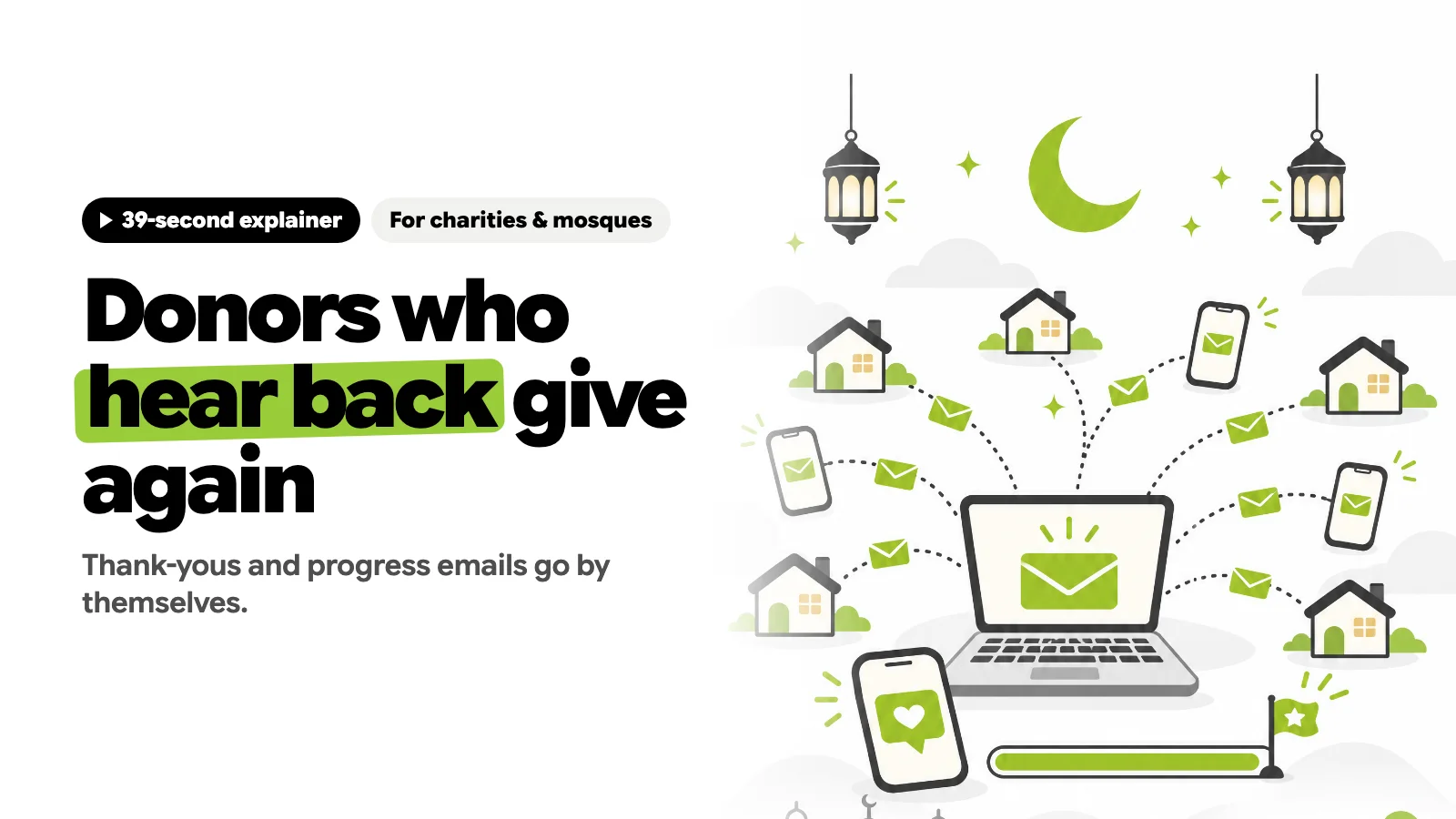
Last Ramadan's donors never heard from you again? So this year, they give somewhere else. Here's the fix. Donor emails that send themselves. After someone's first gift, a welcome goes out. Monthly, recent donors see each appeal's progress. When an appeal passes halfway, or its goal, its donors get thanked. New Ramadan appeal? Click write to supporters, type your message, and press send. Spam worries? Only people happy to hear from you get it, each with an unsubscribe link. Donors kept close, without writing each email. It's one system for charities and mosques: website, donations, Gift Aid and donor records. Book a free demo at ummahdesign.com.
How welcome emails, monthly progress updates and milestone thank-yous go out by themselves, and how a charity writes and sends a Ramadan appeal to supporters who are happy to hear from it. Names, amounts and counts are made-up examples.
Which donor emails should a charity send?
You don't need a newsletter calendar to look after donors. Four or five emails, sent at the right moments, do most of the work.
| When it goes | What it does | |
|---|---|---|
| Receipt | Straight after each gift | Confirms the payment. Sent to every donor. |
| Welcome | A few days after the first gift | Thanks them and says what their money does. |
| Progress update | Once a month | Shows how each appeal is doing. |
| Milestone thank-you | When an appeal passes halfway, and its goal | Tells the people who made it happen. |
| Appeal | When you launch something new | Asks for help, with a link to give. |
The receipt is different from the rest. It confirms a transaction, so every donor gets one. The others are news and appeals, which is where the marketing rules come in.
Who can a UK charity email? Consent and the soft opt-in
There are two ways a charity can send news and appeals by email. The first is consent: the person ticked a box saying yes, email me.
The second is new. Since 5 February 2026, the Privacy and Electronic Communications Regulations include a charitable purpose soft opt-in (regulation 22(3A)), added by the Data (Use and Access) Act 2025. In short, a charity may email someone without a tick when:
- the only purpose of the email is to further the charity's own charitable purposes
- the charity got the person's details while they were showing an interest in, offering or giving support to those purposes, such as making a donation
- the person was given a simple, free way to refuse when their details were collected, and is given one again in every email
That means the opt-out box has to be on the form itself, not tucked away in a privacy policy. The ICO's direct marketing guidance goes into the detail, including how it treats details collected before February 2026, so read it before relying on the soft opt-in. This is general information, not legal advice.
The Fundraising Regulator's code says the same thing from the fundraising side. Under section 8.4 of the Code of Fundraising Practice, you mustn't send fundraising messages to people who have said they don't want them, and you must give people an easy way to opt out, such as an unsubscribe link.
How to write a Ramadan appeal email
An appeal email works best when it's short and asks for one thing. A few habits help:
- Make the subject line specific: "Ramadan is coming: how you can help this year" beats "Our newsletter".
- Use the person's first name, and write as one person to another.
- Say what the money does in concrete terms, such as a food pack for a family.
- Include one clear link to the appeal page.
- Send yourself a test first and read it on your phone.
- Time it well: before Ramadan starts, and again before the last ten nights.
Many charities and mosques run a separate push for the last ten nights, and our guide to automating last ten nights donations pairs well with a well-timed email. For the wider plan, see our Ramadan fundraising guide for charities and mosques.
Where our system fits
Donor emails are part of our all-in-one fundraising system for mosques and charities, alongside the website, donations, Gift Aid and donor records. Three automatic emails can be switched on in the admin:
- A welcome, sent a day to a week after someone's first gift, with a subject and message you write once.
- A monthly progress update on the day of the month you choose, to everyone who gave in the last year, with a progress bar for each active appeal.
- Milestone thank-yous when an appeal passes 50% and 100% of its goal (you can change the points). Each goes once, only to that appeal's donors.
For appeals, you click Write to supporters, type a subject and a plain message, and choose who gets it: everyone who can be emailed, donors to one appeal, or people who gave in the last few months. You see a live count of recipients, can send yourself a test, and confirm before anything goes. Any web address in the message becomes a link, and the first name fills in for each person.
Consent is handled on the forms. The donate, pledge, volunteer and Gift Aid forms show one box. By default it's the soft opt-in wording ("Tick this box if you do not want news and appeals"), or you can switch to a yes box if you'd rather rely on consent. The soft opt-in only counts for people who gave, pledged or signed up on your site from 5 February 2026.
Every marketing email carries an unsubscribe link and a one-click unsubscribe for email apps. An opt-out always wins, and bounced or complained addresses are never emailed again. Receipts still go to everyone.
Emails go out from your charity's own address once your domain is verified with the sending service. Sending to thousands of supporters at once needs a paid plan with that service, which we'll talk through when we set you up.
A thank-you lands better when the gift itself felt good. Letting donors cover the card fee so the whole gift reaches the cause is one small part of that. And email works alongside your other channels, which our social media strategy for Muslim charities covers.
Frequently asked questions
Can a charity email donors without their consent?
Since 5 February 2026, a UK charity can use the charitable purpose soft opt-in, as long as it collected the details itself while the person was supporting its work, offered a clear opt-out at the time and offers one in every email. Read the ICO's guidance before relying on it.
Are donation receipts marketing emails?
No. A receipt confirms a payment, so our system sends one to every donor whatever their marketing choice. The rules on consent apply to news and appeals.
How often should a charity email its donors?
A monthly progress update, plus an appeal when you genuinely need help, is a sensible rhythm for most charities and mosques. Ramadan can justify more, as long as each email has a clear reason to exist.
What happens when someone unsubscribes?
They stop getting news and appeals straight away and are kept on a suppression list. They still receive receipts for any gift they make, and they'd only hear from you again if they ticked yes on a form later.
Will last year's donors get the automatic emails?
Only if they can be emailed. Donors who gave consent can, and so can people who gave, pledged or signed up on your site from 5 February 2026 and didn't tick the opt-out box. Earlier donors without consent are left out.
If you'd like to see donor emails working on a real setup before Ramadan, book a free demo of our charity and mosque fundraising system.