
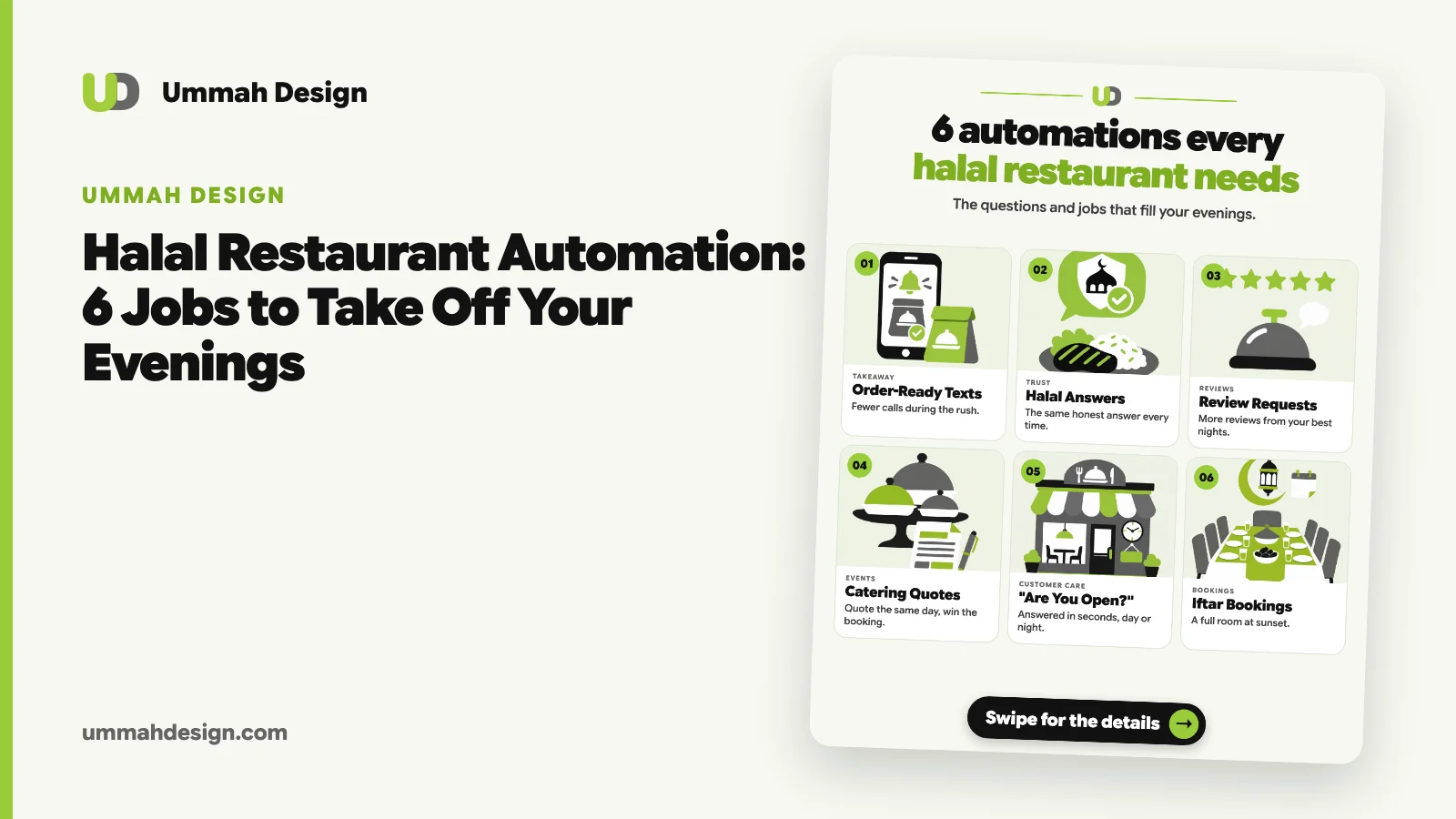
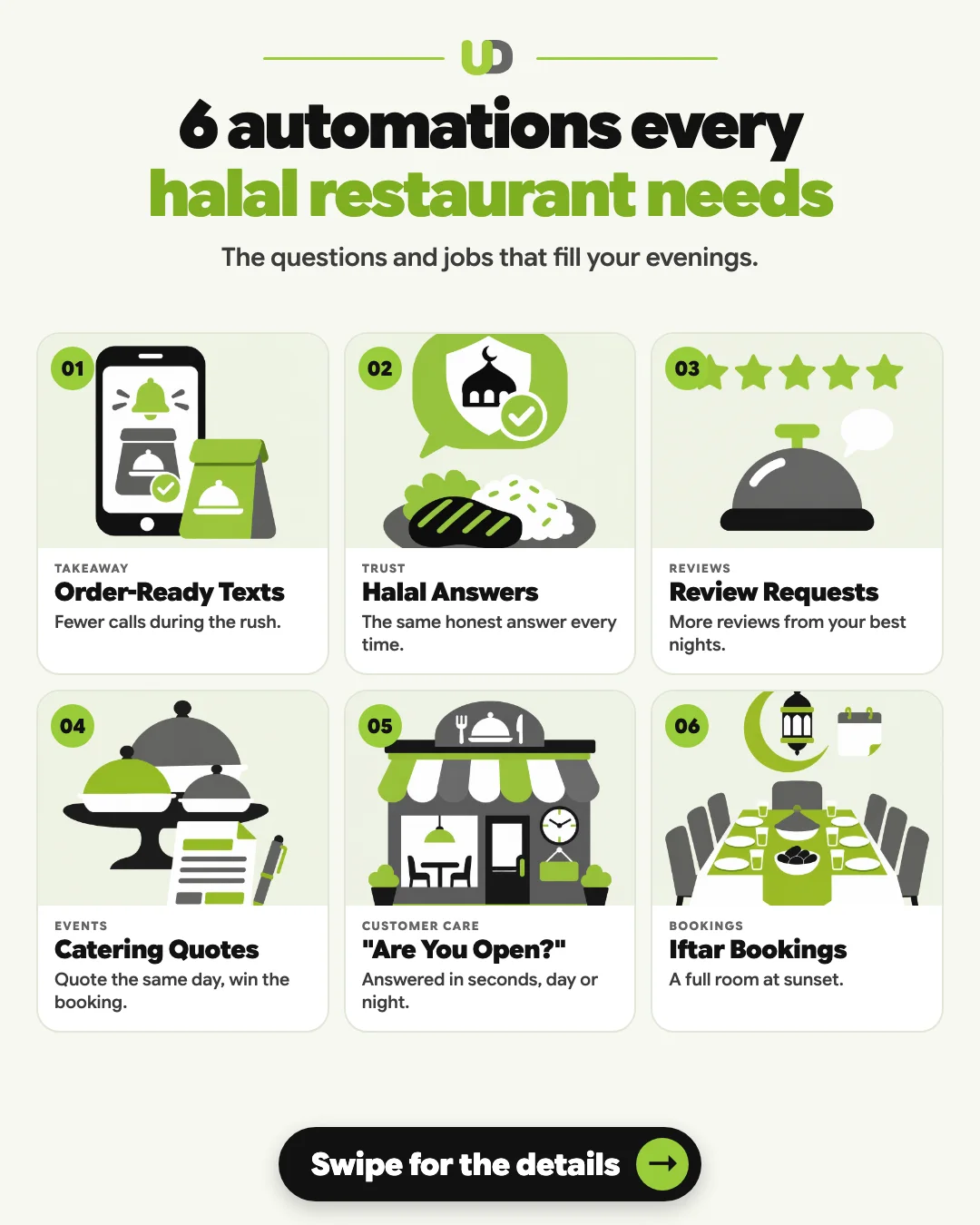
Most of the jobs that fill a halal restaurant's evening are not cooking. They are the same calls and messages, over and over: is my order ready, is your meat halal, are you open, can you do a wedding for 150. This post walks through six automations that take those jobs off your staff: order-ready texts, honest answers to the halal question, review requests, catering quotes, the "are you open?" reply, and iftar and table bookings. For each one you will see what it does, how it works, and what you need to prepare.
None of this replaces the people who run your restaurant. A person still checks anything that matters before it goes out. The automation handles the repeats, so your team can look after the guests in front of them.
What is halal restaurant automation, in plain terms?
It means connecting the systems you already use, your till, online ordering, booking page, WhatsApp, Instagram and Google profile, so that routine messages and tasks happen on their own. A customer asks a question and gets the right answer in seconds. An order is marked ready and the customer gets a text. A catering enquiry arrives and a quote is drafted for you to check.
The trick is that every answer comes from information you have given and approved. Nothing is made up, and nothing commits you to something new without your say.
How do you stop the "is my order ready?" calls?
On a busy Friday or Saturday night, a big share of phone calls are customers asking whether their food is ready. Each call takes a member of staff away from the counter or the pass, and the customer usually ends up waiting by the door anyway.
Order-ready texts fix this simply. We connect your till or online ordering system. When the kitchen marks an order as ready on the kitchen screen, the customer gets a text saying it is ready to collect. For delivery, the customer gets an estimated time when the driver sets off.
The result is quieter phones and customers who arrive when the food is hot, not ten minutes early and annoyed.
What you need
- A till or ordering system that records when an order is ready, or a simple button on the kitchen screen.
- Customers' mobile numbers on the order, which most systems already take.
- The wording of the text, in your restaurant's voice.
How should a restaurant answer "is your meat halal?"
This question arrives every day, by DM, by phone, at the counter. And in many restaurants each member of staff answers it a little differently. One says "yes, all of it", another says "I think so", a third is not sure about the chicken. That inconsistency is what makes customers doubt you, even when everything is in order.
The automation here is mostly about getting the answer right once. You give us your certificate, your supplier details and how your kitchen works. We write one clear answer with you, in your words. Then every halal question on WhatsApp, Instagram or your website gets that answer, with a link to your certificate if you want to share it.
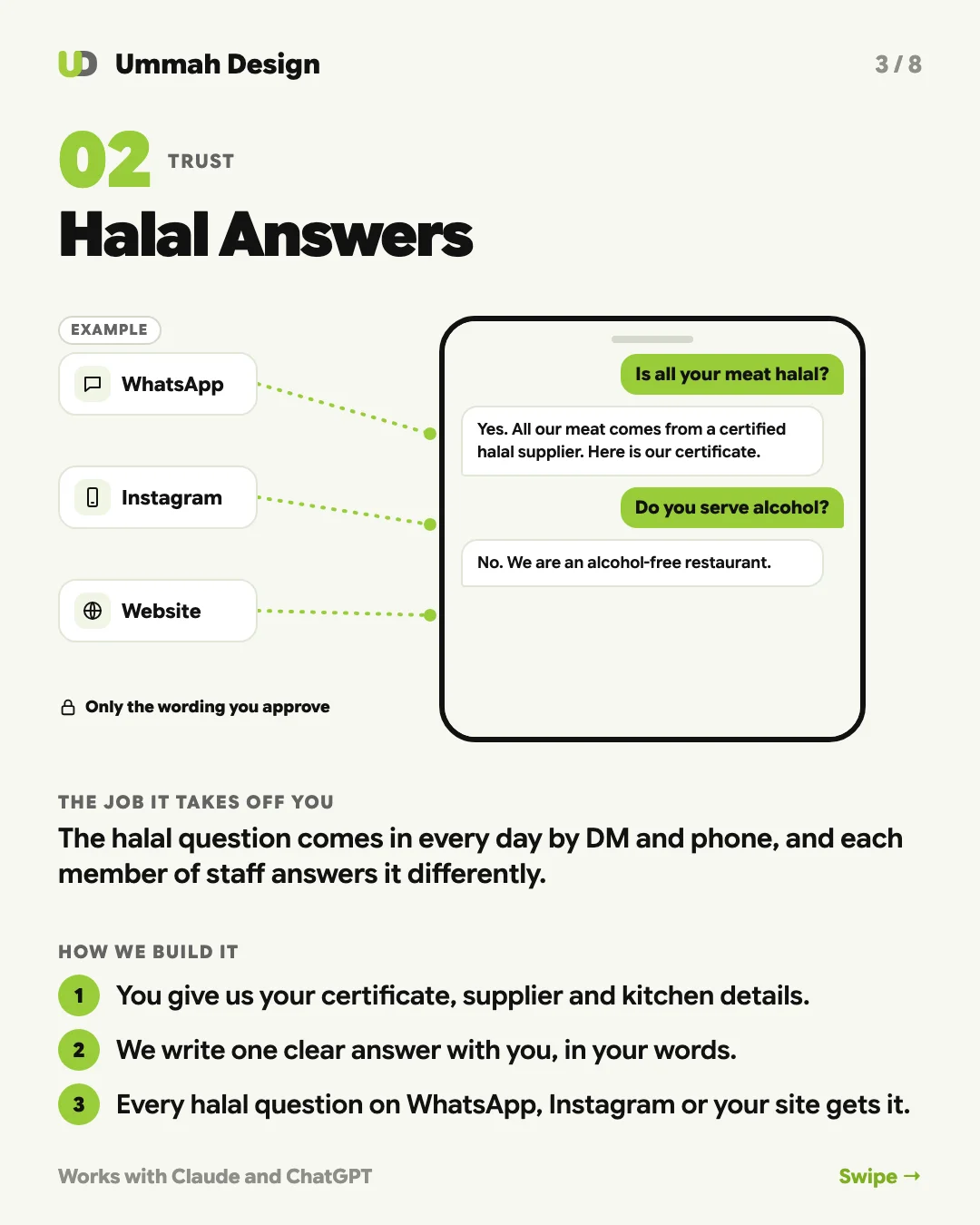
The same goes for related questions: whether you serve alcohol, whether there are separate fryers, whether a dish contains gelatine. We only use wording you have approved. We do not decide what is halal for you, and the automation never claims anything you have not told it. If a question goes beyond the approved answers, it is passed to you.
How do you get more reviews without begging for them?
Happy customers rarely leave a review on their own. They enjoyed the meal, they went home, they forgot. Meanwhile one unhappy customer writes three paragraphs. Over time your rating ends up reflecting your worst nights rather than your usual ones.
A review request automation sends every customer a short thank you the day after their visit or order, with your Google review link. That is all it asks. It does not offer rewards for reviews and it does not filter out people it thinks might be unhappy. Everyone is asked, and you get honest reviews.
When a new review comes in, you get a draft reply to check, edit and post. If someone mentions a complaint in a reply to the thank-you message, it comes straight to you so you can put it right.
How can you quote for catering and weddings faster?
Catering enquiries are some of the most valuable messages a halal restaurant gets: a walima, an aqiqah, a company iftar, an engagement party. They are also the slowest to answer, because you need a dozen details before you can quote. Date, number of guests, buffet or served, dietary needs, venue, budget. So the enquiry sits in the inbox for days, and the family books someone who answered faster.
Here is how we usually build it:
- A short enquiry form collects the date, guest numbers, menu style and dietary needs in one go.
- A quote is drafted from your own packages and prices.
- You check it, change anything you want, and send it.
- If the customer goes quiet, a polite follow-up goes out a few days later.
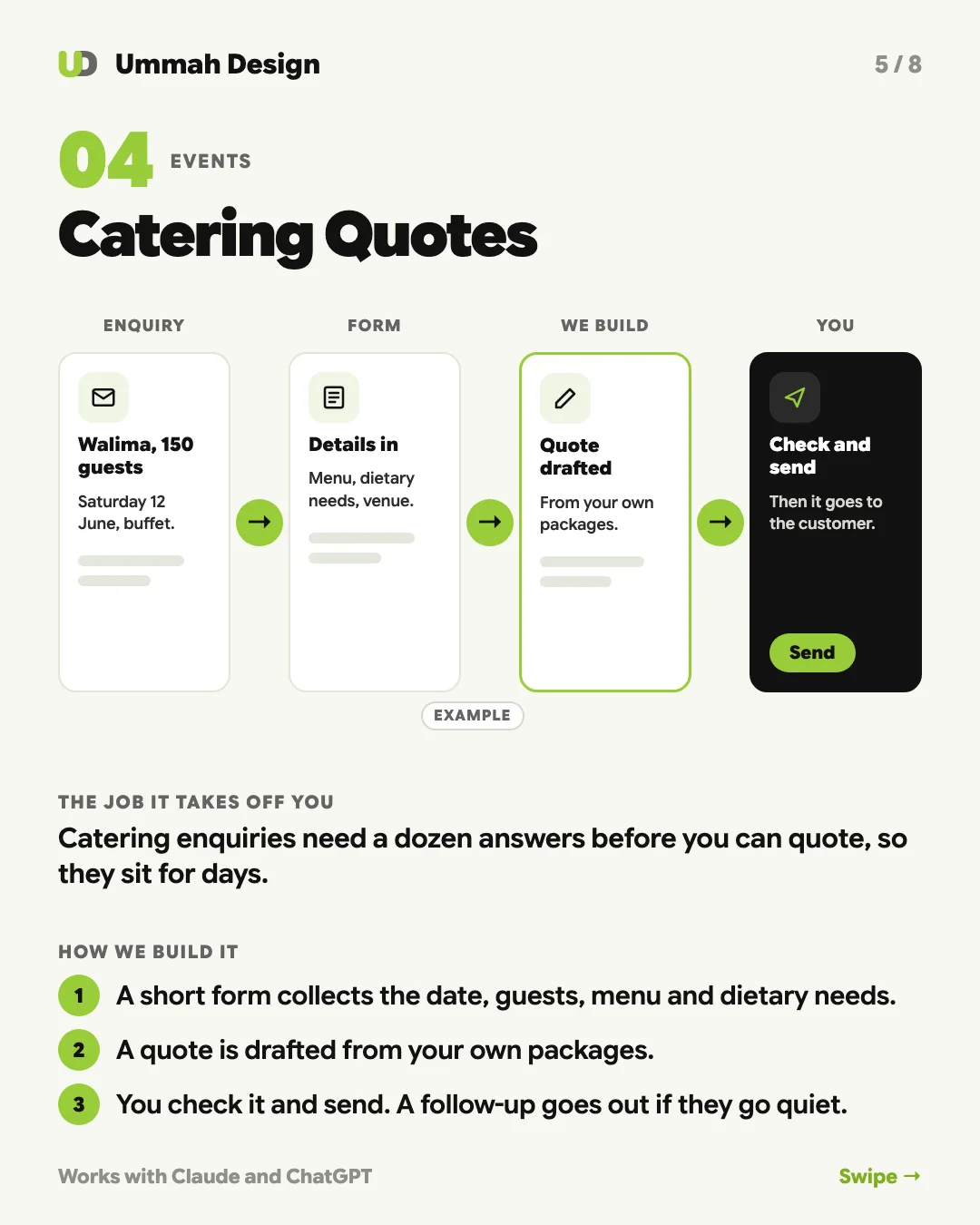
You still send every quote yourself. What changes is that the draft is ready within minutes, instead of waiting for a free evening.
Can a restaurant answer "are you open?" automatically?
Yes, and it is usually the quickest win. Are you open now? Do you deliver to my postcode? Is there parking? Do you have a family area? Is there somewhere to pray nearby? These questions come in all day, on every channel, and they all have fixed answers.
We put your hours, delivery area, parking details and common answers in one place. Every inbox, WhatsApp, Instagram, Facebook, your website and email, replies from that one place, instantly, at any hour. When your hours change for a bank holiday or Ramadan, you update it once. Anything unusual, like a complaint or a large booking, is passed to you with a short note.
If you only build one thing on this list, build this. It is the one that gives staff the most time back on a busy night.
How do you run iftar sittings without double bookings?
During Ramadan, a halal restaurant's busiest moment of the day is fixed by the sunset. Everyone wants a table at the same time. When bookings arrive by phone, DM and walk-in, and live in a paper diary, iftar nights end with double bookings in one corner and empty tables in another.
Online booking with set iftar sittings solves most of it. You decide the sittings and how many covers each one takes. Guests book online, get a confirmation, and get a reminder on the day with a one-tap cancel. A cancelled table opens up again for someone else. You see the whole night's bookings on one screen.
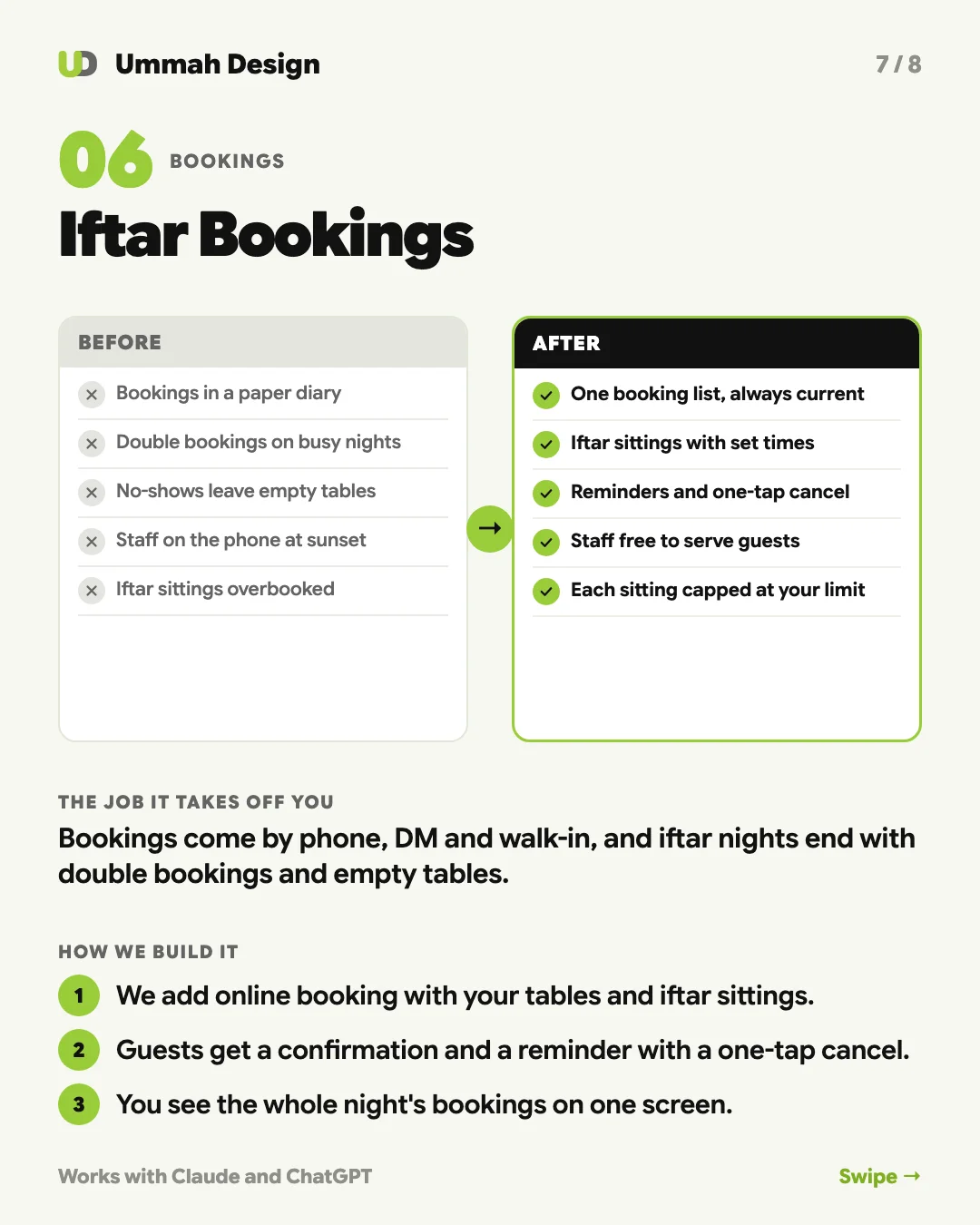
Outside Ramadan the same system takes normal table bookings day and night. If you also want to take orders directly rather than through the delivery apps, our page on a restaurant's own food ordering system explains how that fits alongside bookings.
Where should a halal restaurant start?
Look at last weekend. Which job took the most staff time? For most restaurants the order is roughly this:
- The "are you open?" replies, because they come in constantly.
- Order-ready texts, if you do a lot of collection.
- The halal answer, because consistency builds trust.
- Catering quotes, because each one can be a large booking.
- Bookings and reviews, which run quietly in the background.
These pieces work best when they share one set of information, your hours, menu, packages and approved answers, rather than six separate apps that each need updating. That is what we mean by business systems: one source of truth, many places it shows up. More examples are on our AI automation page.
Frequently asked questions
Do we have to change our till or ordering system?
Usually not. We connect to what you already use where we can. If a system does not allow it, we tell you before building anything.
Will the automation answer questions about halal on our behalf?
Only with the wording you approve. It never decides what is halal, and anything outside your approved answers goes to a person.
What if a customer wants to speak to someone?
They can, at any point. The automation hands the conversation to your team with the details so far.
Is this worth it for a small takeaway?
Often yes, because a small team feels every phone call. Start with one job, usually the "are you open?" replies or order-ready texts.
Talk it through with us
We build these for restaurants and takeaways, connect them to what you already have, and keep a person in charge of what goes out. If you want to see which would help most, book a free 30-minute call.