
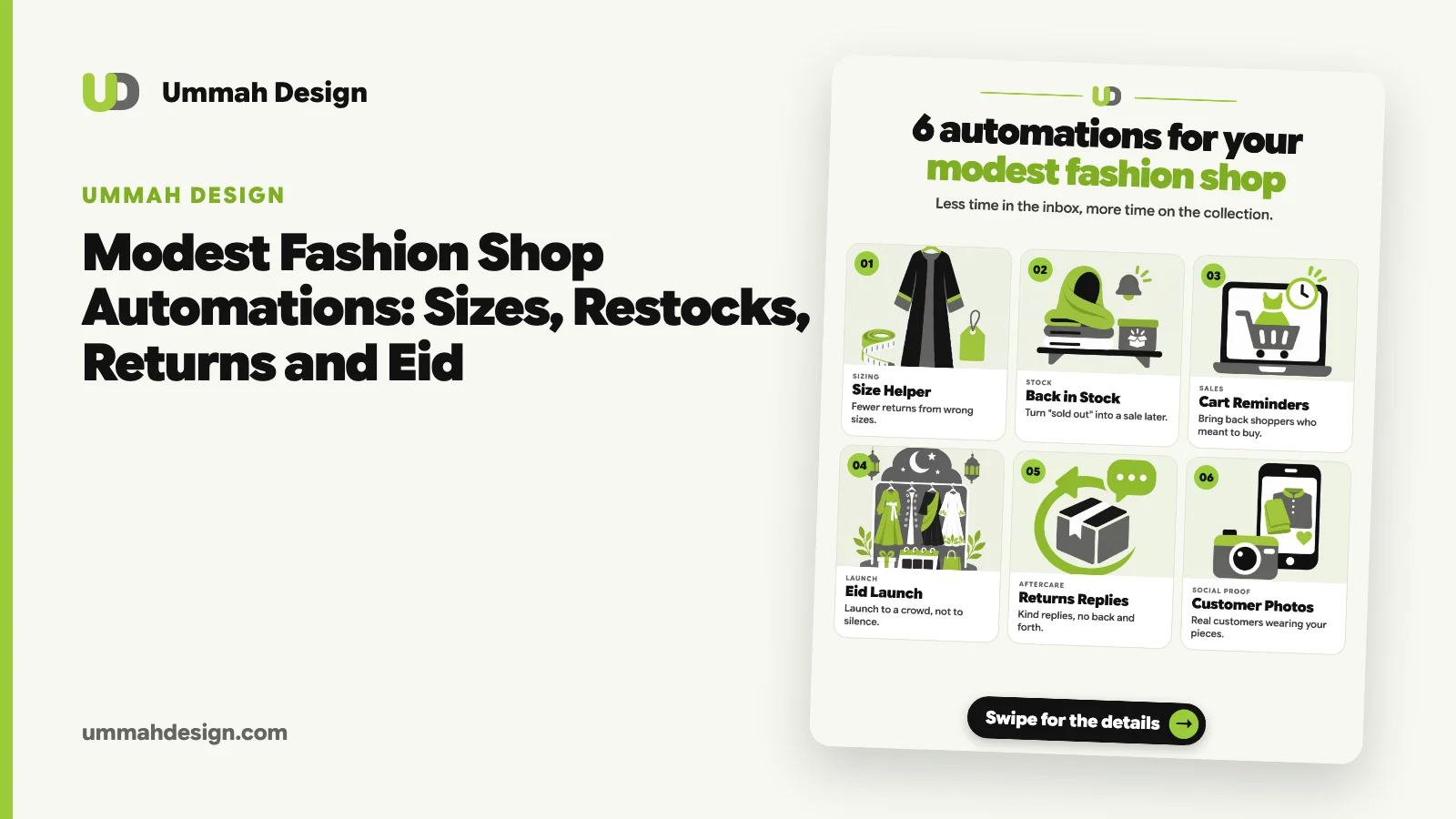
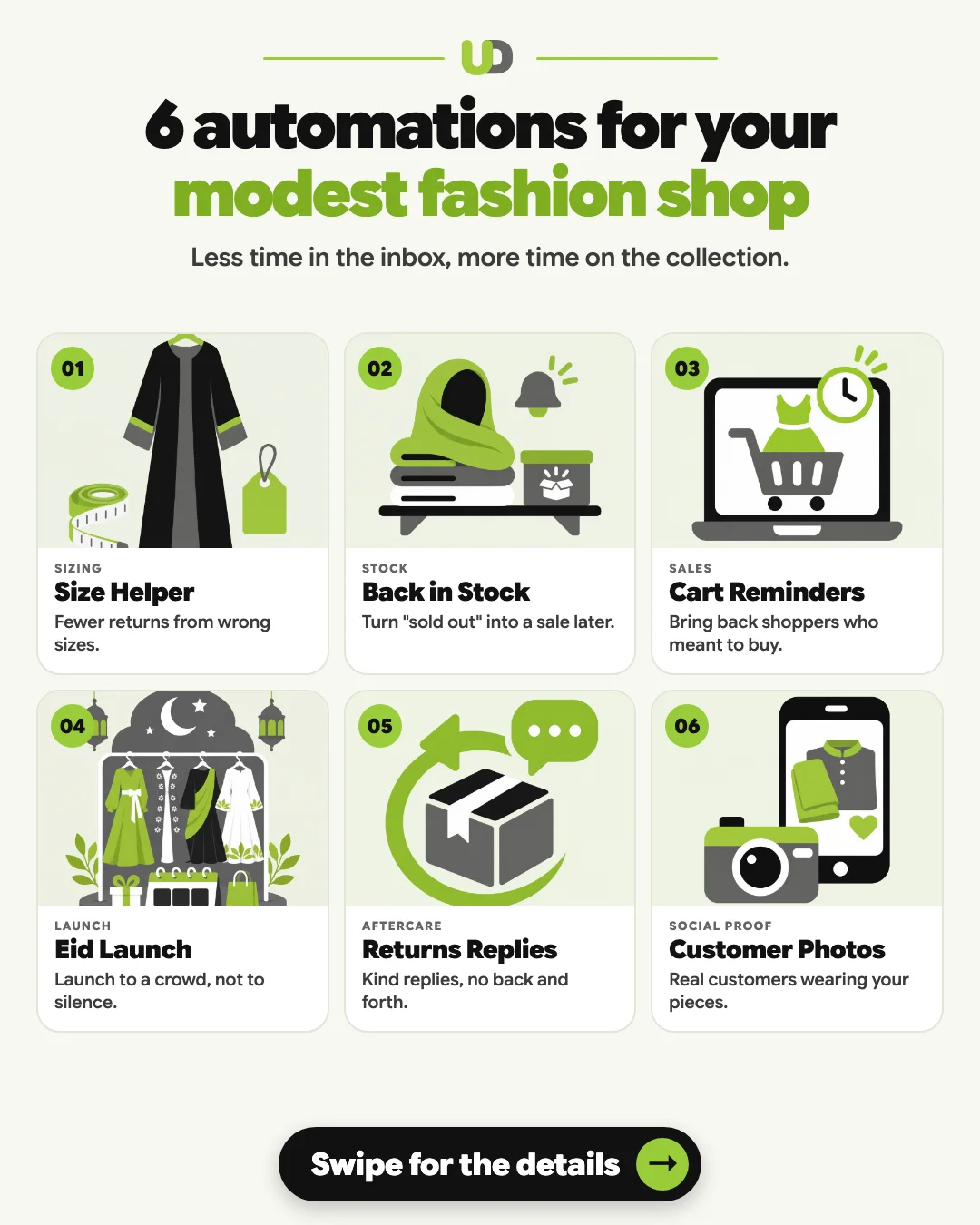
If you run an online modest fashion shop, a large part of your week goes on the same handful of jobs: answering size questions, telling people when a colour is back, nudging shoppers who left a basket, launching the Eid collection, sorting returns and finding the photos customers post in your pieces. This post covers six automations for exactly those jobs, how each one works, and what you need to prepare so it sounds like your brand rather than a robot.
The aim is simple: less time in the inbox, more time on the collection. A person stays in charge throughout, and anything unusual comes to you.
Why do modest fashion shops get so many repeat questions?
Because modest clothing depends on fit and length in a way that a T-shirt does not. An abaya that is two inches too short is a return. A jilbab that runs narrow is a return. Shoppers know this, so they ask before they buy, and they ask in DMs, comments, WhatsApp and email. The questions are reasonable. There are just a lot of them, and they arrive at midnight as often as at midday.
The good news is that most of these questions have answers you already know. They are in your size chart, your fit notes and your returns policy. The automations below put that knowledge to work.
Can a size helper really answer "which size?"
Yes, as long as it answers only from your information. We load your size charts, your lengths for each style and your own fit notes, things like "this one is roomy across the shoulders" or "take your usual size". When a shopper asks in your DMs or on your product page, the helper answers from those notes.
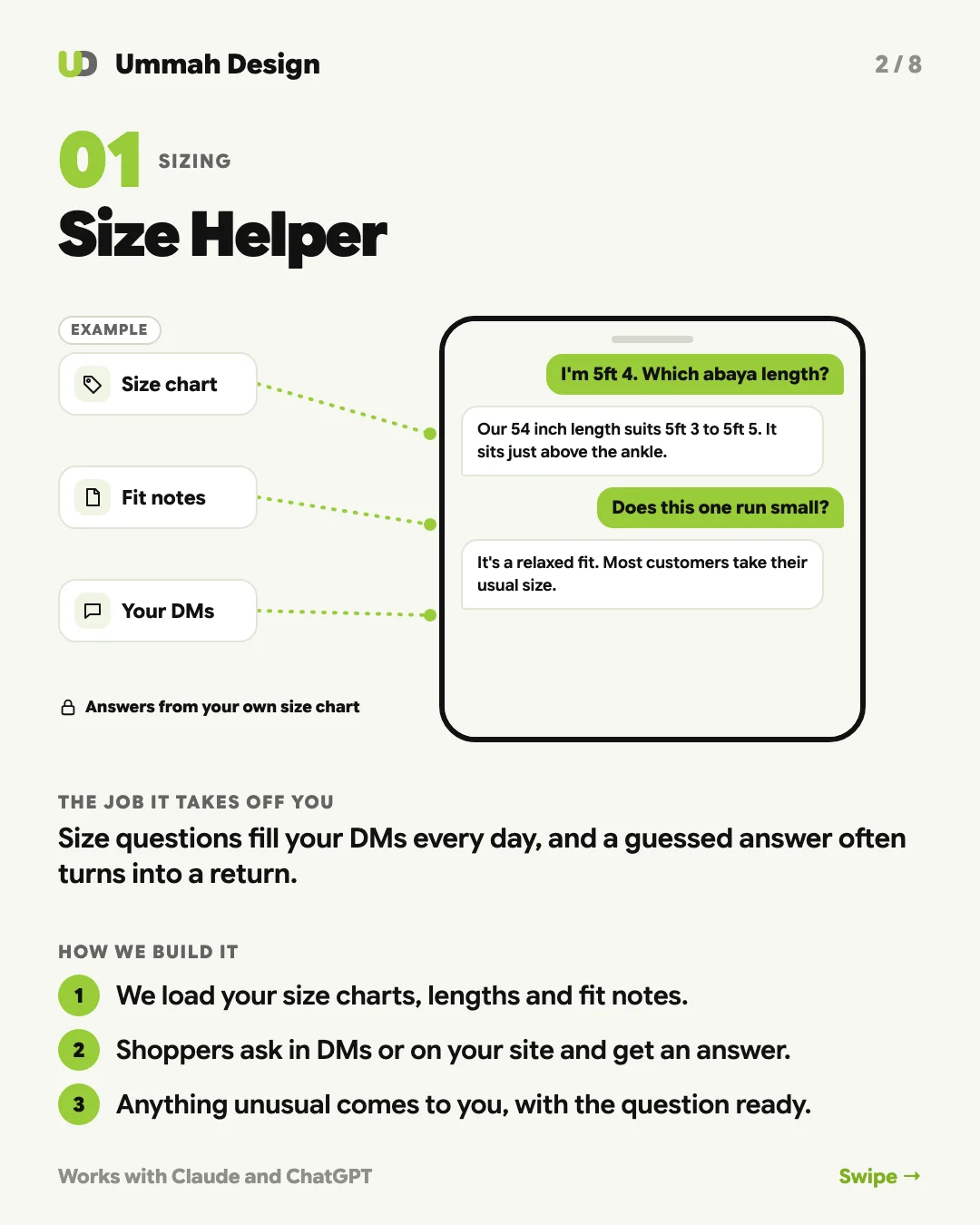
For example, someone who is 5ft 4 asks which abaya length to choose. The helper looks at your chart, sees that your 54 inch length suits 5ft 3 to 5ft 5, and says so, adding that it sits just above the ankle. Another asks whether a style runs small, and gets your own fit note back.
When the question is tricky, a pregnancy, an unusual height, a request to alter a hem, the helper does not guess. It passes the question to you, with the conversation so far, so you can answer properly. Fewer wrong sizes going out means fewer parcels coming back.
What to prepare
- Your size chart for each style, with the actual garment measurements.
- Lengths in inches or centimetres, and the height range each length suits.
- A line or two of honest fit notes per style.
How do back-in-stock alerts work?
When a popular colour sells out in size M, most shoppers simply leave. You never find out how many wanted it, and they may never come back.
A back-in-stock alert adds a "tell me when it's back" button to sold-out sizes and colours. The shopper leaves their email. When you restock, in your shop as you normally would, everyone waiting for that exact size and colour gets an email with the link straight away.
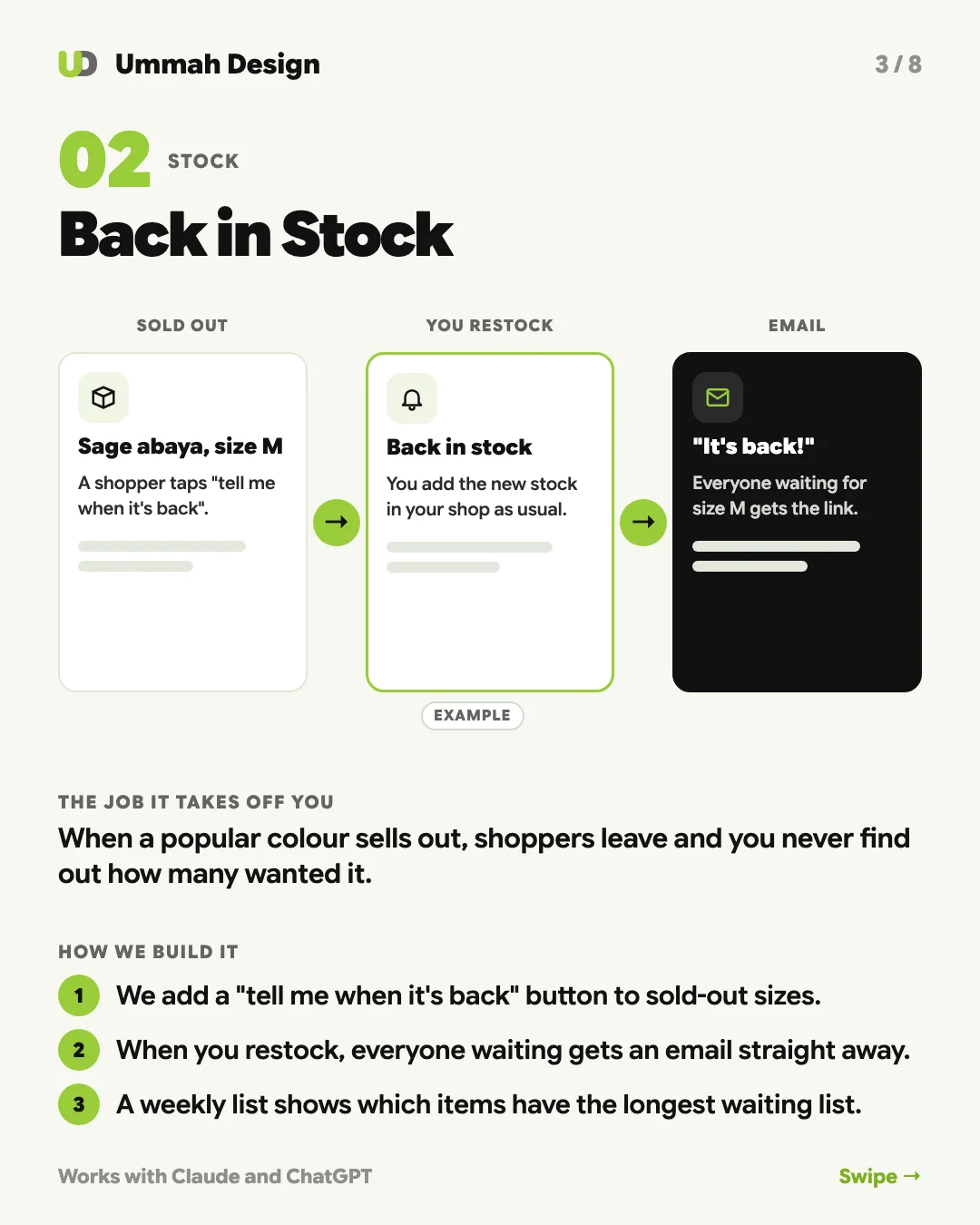
There is a second benefit that shop owners often value more than the sales. A weekly list shows which items have the longest waiting lists. That is real demand, from real customers, and it makes your next reorder far less of a guess.
Do abandoned-cart reminders annoy customers?
They can, if there are too many of them or they sound pushy. Done gently, they help people who genuinely meant to buy. Shoppers fill a basket, get pulled away by the school run or a phone call, and forget.
We connect your Shopify or online shop and set up two reminders at most. The first goes out about an hour later, a friendly "you left something behind" showing the exact items and sizes. The second goes out the next day. Then it stops. Nobody is chased for a week.
We write the wording with you, so it sounds like your brand. No fake countdown timers and no invented "only one left" warnings. If you sell on Shopify, our page on Shopify AI automation covers how this fits with the rest of your store.
How do you plan an Eid collection launch?
Many shops spend months on an Eid collection, then launch it with one rushed Instagram post the night before and hope people see it. A launch works far better when people are already waiting for it.
Here is a plan we often build, counted back from launch day:
- Four weeks before: an early-access sign-up on your website and Instagram.
- One week before: a sneak peek email to the waiting list.
- Three days before: a countdown message with the launch time.
- Launch: the waiting list gets the link first, then your Instagram post and story go out.
- Cut-off: a clear last order date for delivery before Eid.
Each step is written in advance and sent on the days you choose, so on launch day you are watching orders rather than writing emails. For Eid al-Fitr 2027, expected around 10 March, that means an early-access sign-up going live in early February.
Can returns be handled without the back and forth?
Every return request means the same routine: find the order, check the date against your policy, check the item is eligible, then type out the same instructions again. Customers wait a day for a reply, and a return that could have been an exchange becomes a refund.
A returns automation connects to your orders and loads your returns policy. When a request comes in, the order is found, the policy is checked, and a reply is drafted for you. If the problem was the size, the reply offers an exchange size first. You approve it, and the customer gets the label or the steps.
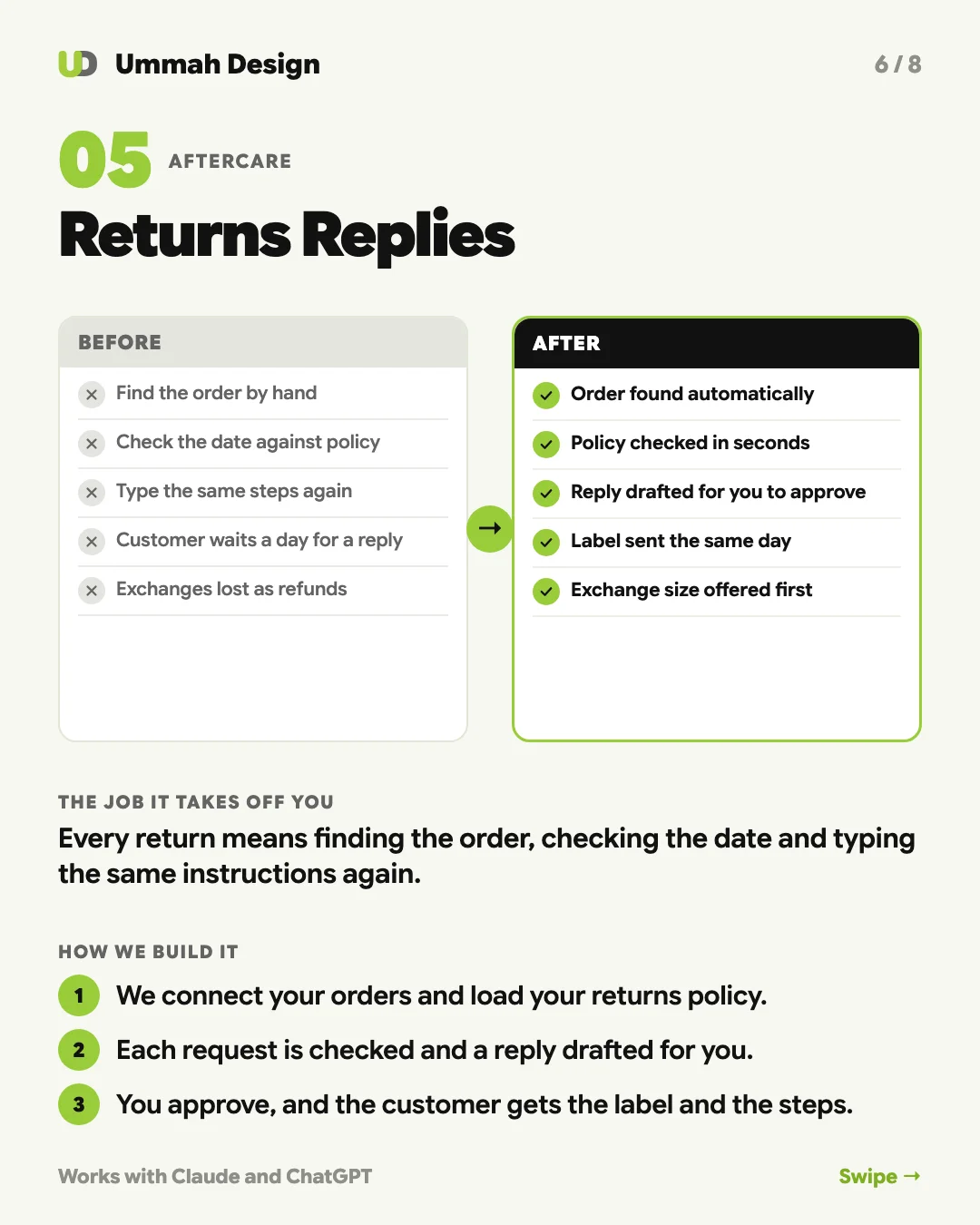
You keep the final say on every return. What disappears is the searching and retyping.
How do you find and reuse customer photos?
Customers post lovely photos in your pieces, on Instagram, in stories, on TikTok. Those photos are the most convincing thing a shop can show a new buyer. They also get lost in your notifications within a day.
A photo finder watches for posts and stories that tag your shop and saves each one to a folder, with who posted it and when. It then drafts a polite message asking whether you may reshare the photo. You send it. Nothing is reshared without a clear yes, and the permission is saved with each photo, so you can use it later on product pages with a clear conscience.
Which automation should a modest fashion shop build first?
It depends on where your week goes. A rough guide:
- If your DMs are full of size questions, start with the size helper.
- If you sell out often, start with back-in-stock alerts.
- If Eid is your biggest season, start planning the launch now.
- If returns take an afternoon a week, start with returns replies.
Most shops end up with three or four of these working together, all reading from the same product, stock and order information. You can see more examples on our AI automation page.
Frequently asked questions
Does this only work on Shopify?
Shopify is the most common, but we work with other online shop platforms too. We check what your platform allows before we start.
Will customers know they are talking to an automation?
Yes. We make it clear, and anyone can ask to speak to a person at any time.
What if the size helper gets it wrong?
It only answers from your charts and notes, and passes anything uncertain to you. If a note is unclear, we fix the note, and every future answer improves.
Do you need access to our customers' data?
Only what each job needs, such as an order to process a return. We never sell or share customer data.
Want to spend more time on the collection?
We build these for modest fashion shops and connect them to the shop you already have. If you would like to talk through which ones fit, book a free 30-minute call.