Pledge tracking means recording every promise made at your fundraising dinner (who, how much and when), splitting it into payments, reminding each donor before a payment is due and seeing at a glance what's overdue. Get those four things right and more of the money promised in the room actually reaches the bank. Our fundraising system does all four, and each paid instalment becomes an ordinary donation on the appeal's total.
Most charities and mosques know the pattern. The night goes brilliantly, the host reads out the pledges, and the total on the board is something to be proud of. Then the spreadsheet starts. Three months later someone is still working through a list of names, ringing people who meant every word but simply forgot.
What the video says
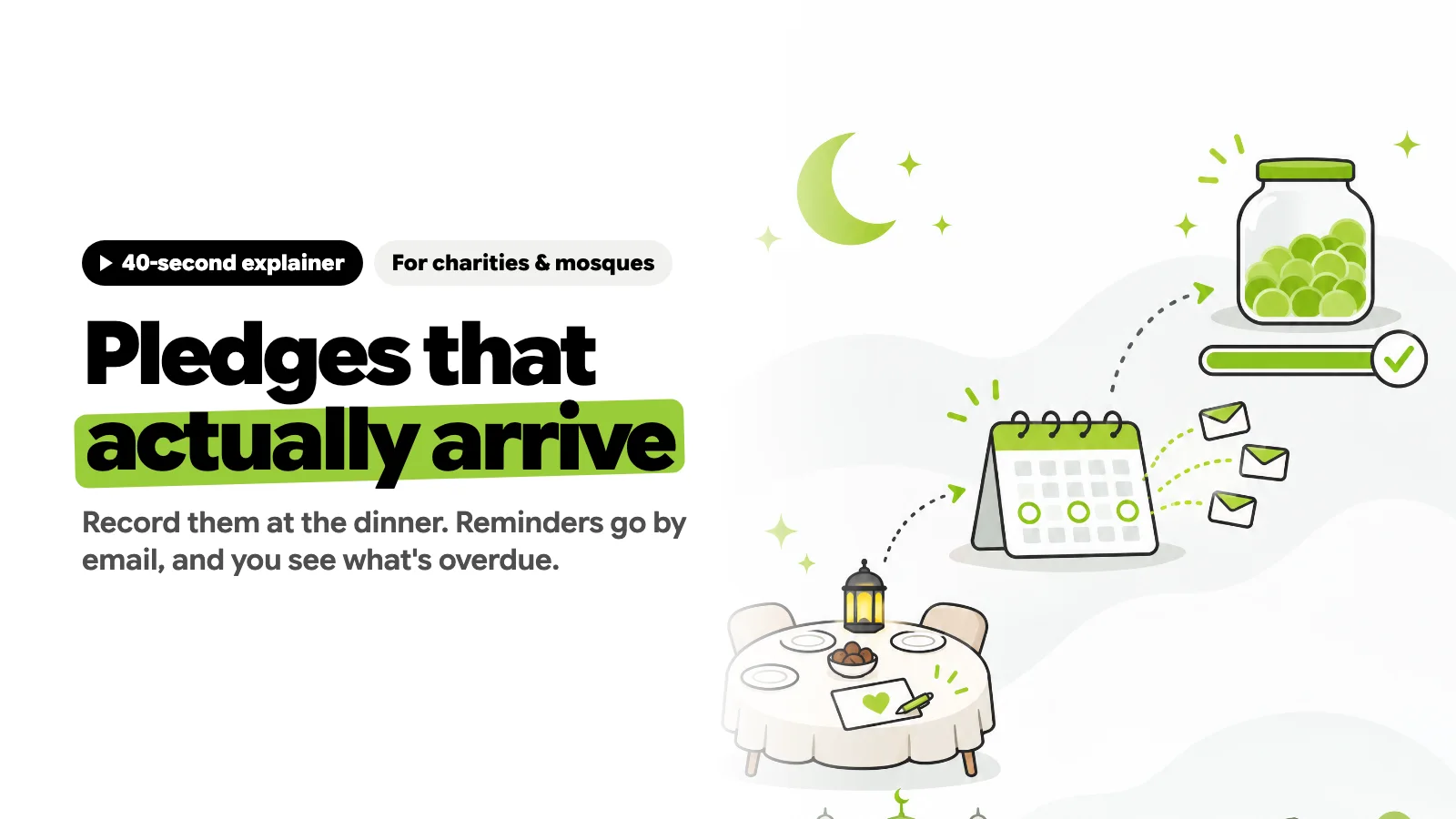
Forty thousand pledged on the night. How much gets paid? Here's the fix: a pledge tracker for your Ramadan appeal. At the dinner, each pledge is recorded on the spot: who, how much, and when. It can show on the appeal's progress bar. Before each payment is due, a reminder email goes out with a link to pay. Paid? It's a donation, straight onto the total. Donors see what's left in their account. Your team sees what's overdue. So more of what's promised in the room actually arrives. Interest-free loans? Tracked too, with a register for trustees. One system for charities and mosques: website, donations, Gift Aid, donor records. Book a free demo at ummahdesign.com.
How pledge tracking works after a fundraising dinner: each pledge is recorded on the spot, a reminder email with a link to pay goes out before each instalment, paid instalments become donations on the total, and staff see what's overdue. Names and amounts are made-up examples.
Why do fundraising dinner pledges go unpaid?
Rarely because people change their minds. Pledges slip for ordinary reasons. The donor wasn't sure when the first payment was due. Nobody reminded them. The way to pay was a bank detail on a card they've since lost. And on the charity's side, nobody could say who had paid what, so the follow-up calls went to the wrong people or didn't happen at all.
Each of those is a gap in the process, and the goodwill was there all along. Pledge tracking closes the gaps one by one.
How does pledge tracking work, from the dinner to the bank?
- Record the pledge on the spot. Staff open "Record a pledge or loan" and enter the name, email, amount and appeal. The form's own note says it's for a pledge taken by phone, after Jumu'ah or at a dinner.
- Agree the plan. Choose one payment by a date, or instalments: how many, every month or every week, and when the first is due. A £1,200 pledge over six months becomes six payments of £200, split equally to the penny.
- A reminder goes out before each payment. A few days before each instalment is due (three by default, and you can set anything up to fourteen), the donor gets an email: "Your pledge payment is due on 1 March", with a button to pay by card, plus your bank details if you've added them.
- Paid instalments become donations. A card payment through the reminder is recorded automatically. Cash, cheques and transfers are marked paid by staff. Either way, it becomes an ordinary donation on the appeal's total, and Gift Aid works as it does for any donation.
Nothing counts as raised until money arrives. That keeps your appeal total honest, while the promised amount is tracked separately.
Can pledges show on the appeal's progress bar?
Yes, if you want them to. It's off by default. Switch it on and the appeal page shows what's still pledged as a lighter band behind the raised amount, with a line such as "£18,000 pledged". The mosque donation screen in the hall adds "more promised" in the same way. As each instalment is paid, the raised part grows and the pledged part shrinks by the same amount.
Pledges can also come in through a pledge form on your website. Those need a quick Confirm from staff before they count or get reminders, so a joke entry never lands on your total.
What do donors and staff see?
Donors who sign in to their account see a "Your pledges" section: how much they pledged and to which appeal, what they've paid, what's left, and when the next payment is due, with a Pay now button.
Staff see the other side. The pledges page shows how much is still pledged, how much is overdue and from how many donors, and a list of instalments that are overdue or due in the next two weeks. Each can be marked paid, or released if the charity agrees to let a donor off an instalment.
One thing worth being clear about: there's one reminder before each due date, by email. The system doesn't keep chasing once a payment is late. The overdue list tells your team exactly who to call, and a personal call from someone they sat with at the dinner is often the better follow-up anyway.
Interest-free loans, kept apart
Some supporters offer an interest-free loan (qard hasan) rather than a donation, especially for a building appeal. Those are recorded in the same place but kept apart. A loan is never counted as raised, its schedule is what the charity repays, and it doesn't qualify for Gift Aid. The loan register shows each lender, what they lent, what's been repaid and what's still owed, with a CSV download for trustees. The admin also gets an email listing loan repayments due in the coming week or already missed.
Pledge management tips for your next fundraising dinner
- Ask for an email address on every pledge card. Without one, no reminder can go out.
- Agree the payment plan at the table, while the donor is with you, and write the first payment date down.
- Enter the pledges the same night or the next morning, before the cards go missing.
- Keep ticket money and donations separate. HMRC says a ticket for a fundraising dinner does not qualify for Gift Aid, but a pledge paid as a donation can, with a valid declaration.
- Keep good records. The Charity Commission's fundraising guidance for trustees (CC20) asks charities to record each donor's name, contact details, the amount and when it was made.
- Decide before the night whether pledges show on your progress bar, and tell the host.
Our article on Gift Aid for mosques and charities covers declarations in more detail, and the Ramadan fundraising guide shows where a dinner fits in the wider season.
Where our system fits
Pledge tracking is part of our fundraising system for mosques and charities, which also runs your website, appeals, donations, Gift Aid and donor records. Because a paid instalment is a normal donation, it shows up everywhere a donation does: the appeal total, the donor's record, their receipts and your Gift Aid claim. The reminder's pay button opens your own donate page, so it's worth making sure that page works well on a phone. Our guide to a donation page that converts on a phone covers that.
Frequently asked questions
What is pledge tracking?
It's keeping a record of every promise of money (who, how much and when), splitting it into payments, reminding donors before each one is due and seeing what's been paid and what's overdue.
Do donors get reminded automatically?
Yes. A reminder email goes out a few days before each instalment is due, with a button to pay by card, and your bank details if you've added them. There's one reminder per instalment. Overdue payments are listed for your team to follow up.
Do pledges count towards the appeal total?
Not until they're paid. Each paid instalment becomes a donation on the total. You can choose to show the amount still pledged as a separate band on the progress bar.
Can we claim Gift Aid on pledge payments?
A pledge paid as a donation can qualify, like any other donation, when the donor has a valid Gift Aid declaration. Dinner tickets don't qualify, and interest-free loans aren't donations at all.
Can we track interest-free loans as well as pledges?
Yes. Loans are recorded in the same place, kept apart from donations and never counted as raised. A loan register for trustees shows what's still owed and can be downloaded as a CSV.
Before your next dinner, book a free demo of our charity and mosque fundraising system and we'll show you a pledge going from the table to the total.