

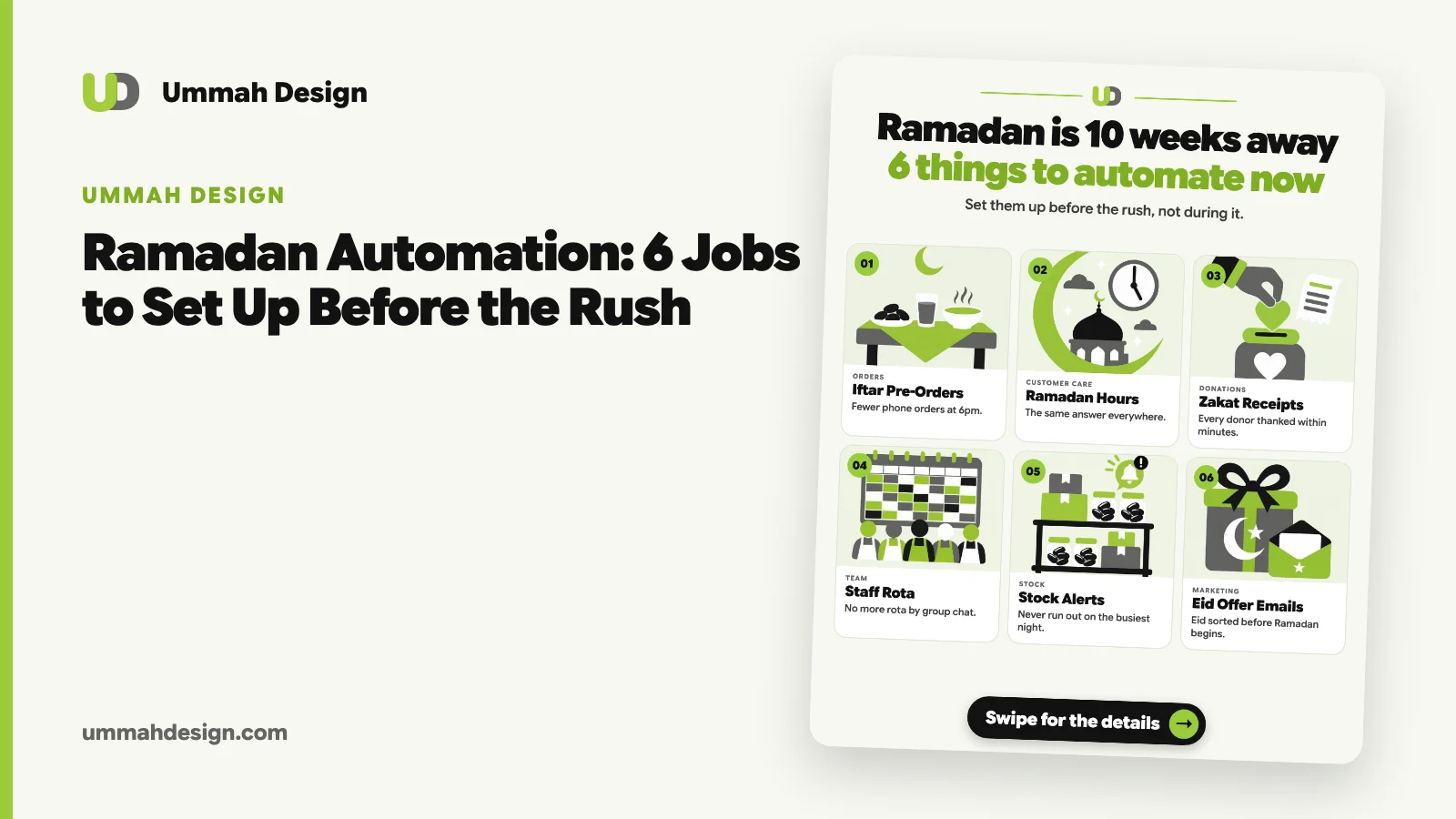
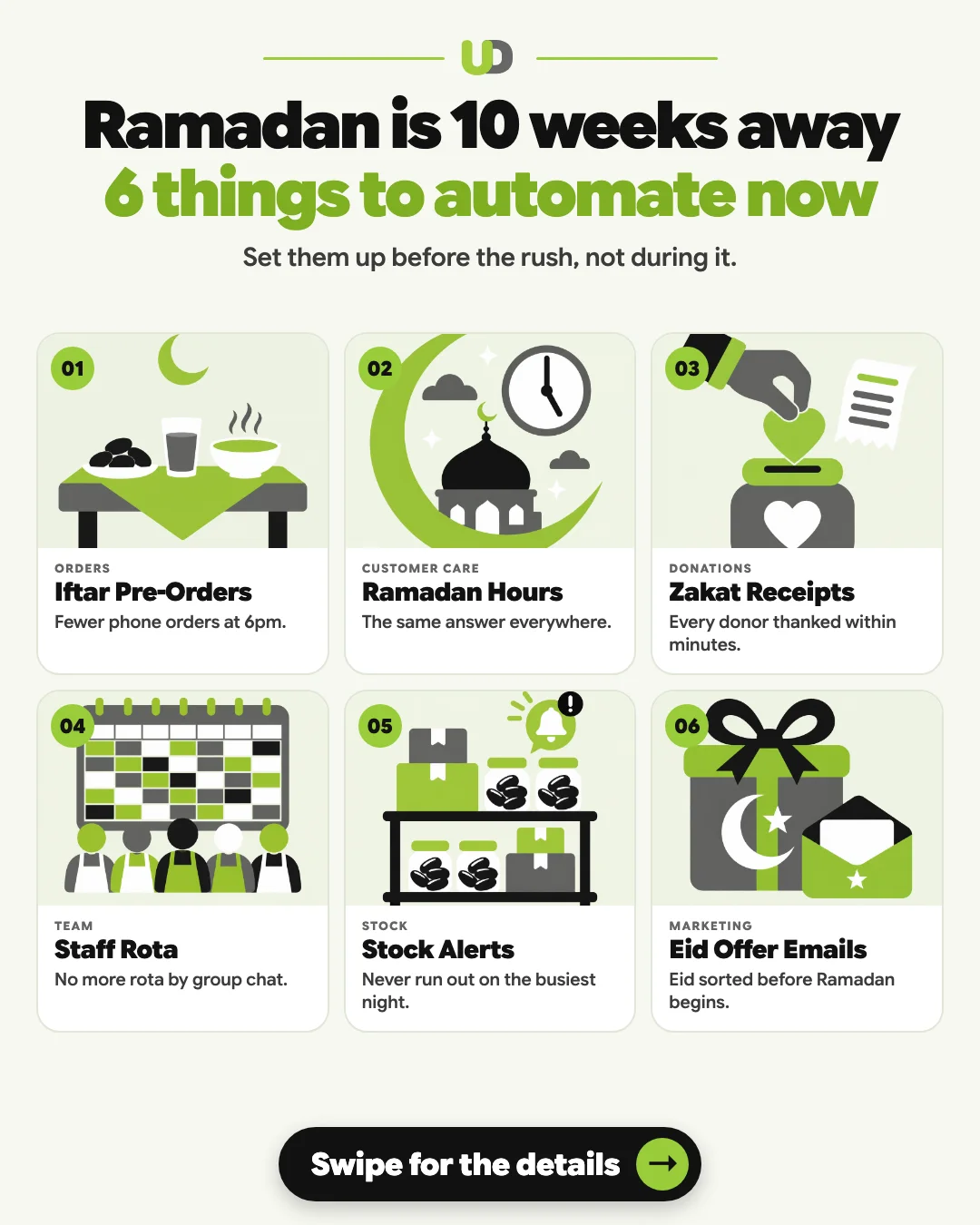
Ramadan 2027 is expected to begin around 8 February, depending on the moon sighting, which puts it about ten weeks away. This post covers six jobs a Muslim-owned business can automate now, before the rush: iftar pre-orders, Ramadan opening hours, Zakat and donation receipts, the staff rota, stock alerts and Eid offer emails. For each one we explain the problem, what the automation does, and what to get ready this month.
Some of these suit a restaurant or takeaway, some a shop, and one is for charities and mosques. Pick the ones that match your business. Even one or two will take a lot of pressure off the month.
Why set up Ramadan automation in November or December?
Because nobody builds anything well in the middle of Ramadan. You are fasting, the evenings are full, staff hours change, and the busiest weeks of the year arrive at the end, in the last ten nights and the run-up to Eid. Anything new you try to set up then gets rushed or dropped.
Ten weeks is enough time to do this properly. A few weeks to agree what you want, a couple of weeks to build and test it, and a quiet week in January to run it on real customers before the month begins. That last part matters. You want the small problems found in January, not on the first night of iftar.
How do you take iftar pre-orders without the phone ringing all evening?
If you run a restaurant, takeaway, bakery or caterer, you already know the pattern. From about four o'clock the phone does not stop. Orders get written on the back of receipts, someone forgets to note the collection time, and a family turns up at 5:30 for a tray of food the kitchen never heard about.
An iftar pre-order system moves most of those calls to a form. Customers order on your website or on WhatsApp, choose the date, the number of people and a collection time, and get a confirmation straight away. Behind the scenes, each order is checked against a daily limit you set, so you never promise more trays than the kitchen can make. When a day is full, the form says so and offers the next day.
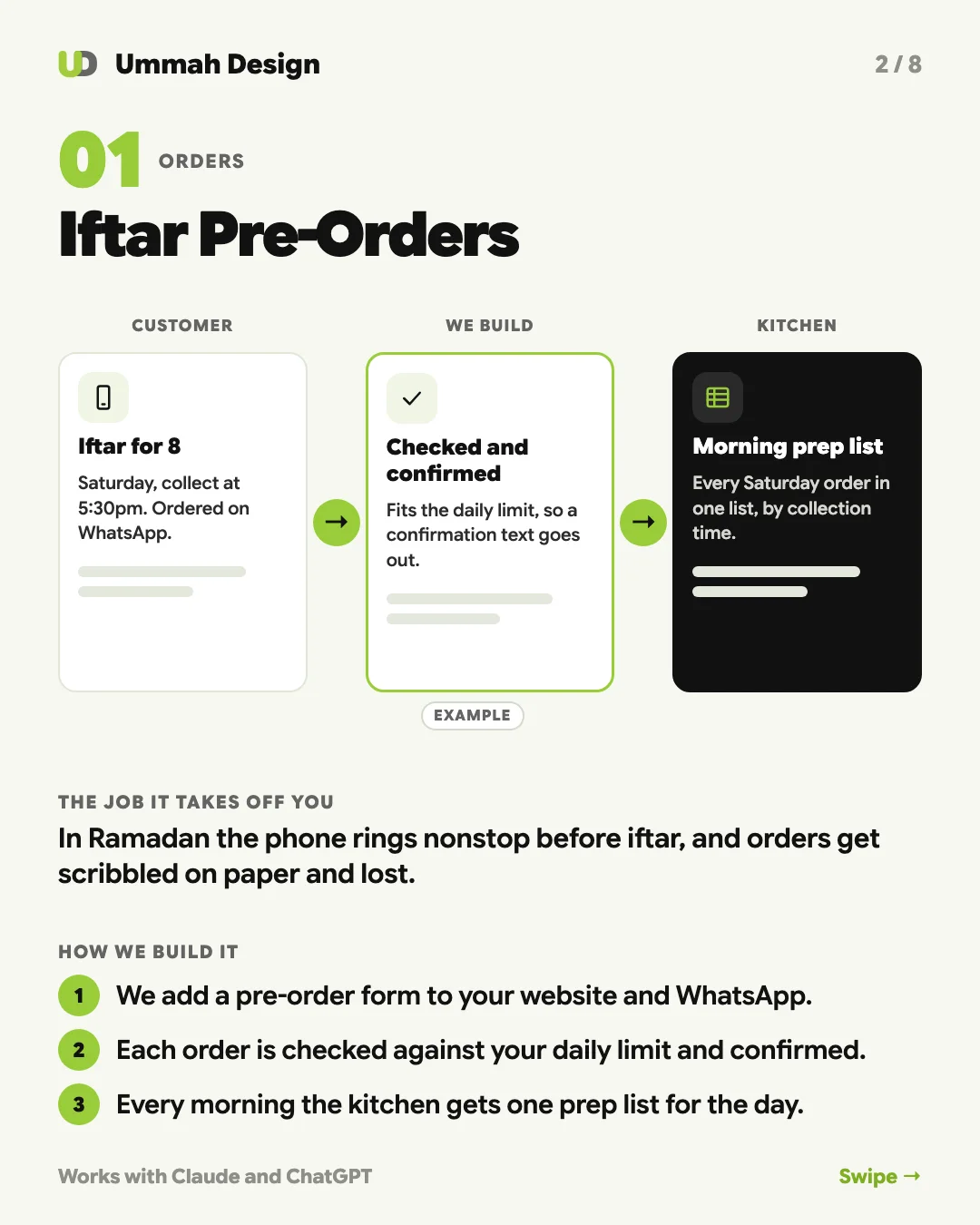
The piece kitchens like most is the morning prep list. Every day, one list arrives with that day's orders grouped by collection time, so the team knows exactly what to cook and when. No reading through messages, no slips of paper.
What to get ready now
- Your Ramadan menu or set boxes, with prices you are happy to publish.
- A realistic daily limit for each item, based on what the kitchen can produce.
- Your collection windows and whether you will deliver.
We cover the wider case for owning your ordering in our guide to an online food ordering system.
How do you keep Ramadan opening hours right everywhere?
Ramadan hours are different for almost every business. A restaurant might open at four and close at two in the morning. A shop might close for an hour at iftar. Then Eid day is different again.
The trouble is that your hours live in six places: your website, Google Maps, Instagram, Facebook, WhatsApp replies and email signatures. Someone updates two of them and forgets the rest, and customers arrive to a locked door.
The fix is one place for your hours, with dates attached. You enter your Ramadan hours, your Eid hours and the date things go back to normal. Every reply about opening times, on WhatsApp, Instagram or your website, reads from that one place. Your website and Google profile change on the dates you pick, and switch back after Eid without anyone remembering to do it.
Can Zakat and Sadaqah receipts be sent automatically?
Yes, and for charities and mosques this is often the biggest win of the month. Ramadan is when most people give, and many give their Zakat in the last ten nights. If receipts are typed by volunteers in the evening, donors wait days for a thank you and the records fall behind.
With the donation page or payment account connected, each gift triggers a receipt within a minute or so. The receipt names the fund the donor chose, Zakat, Sadaqah or a specific appeal, shows the amount, and says whether Gift Aid has been claimed on it. That same night the gift is added to your donor record and to your Gift Aid list, so the claim is ready when you need it.
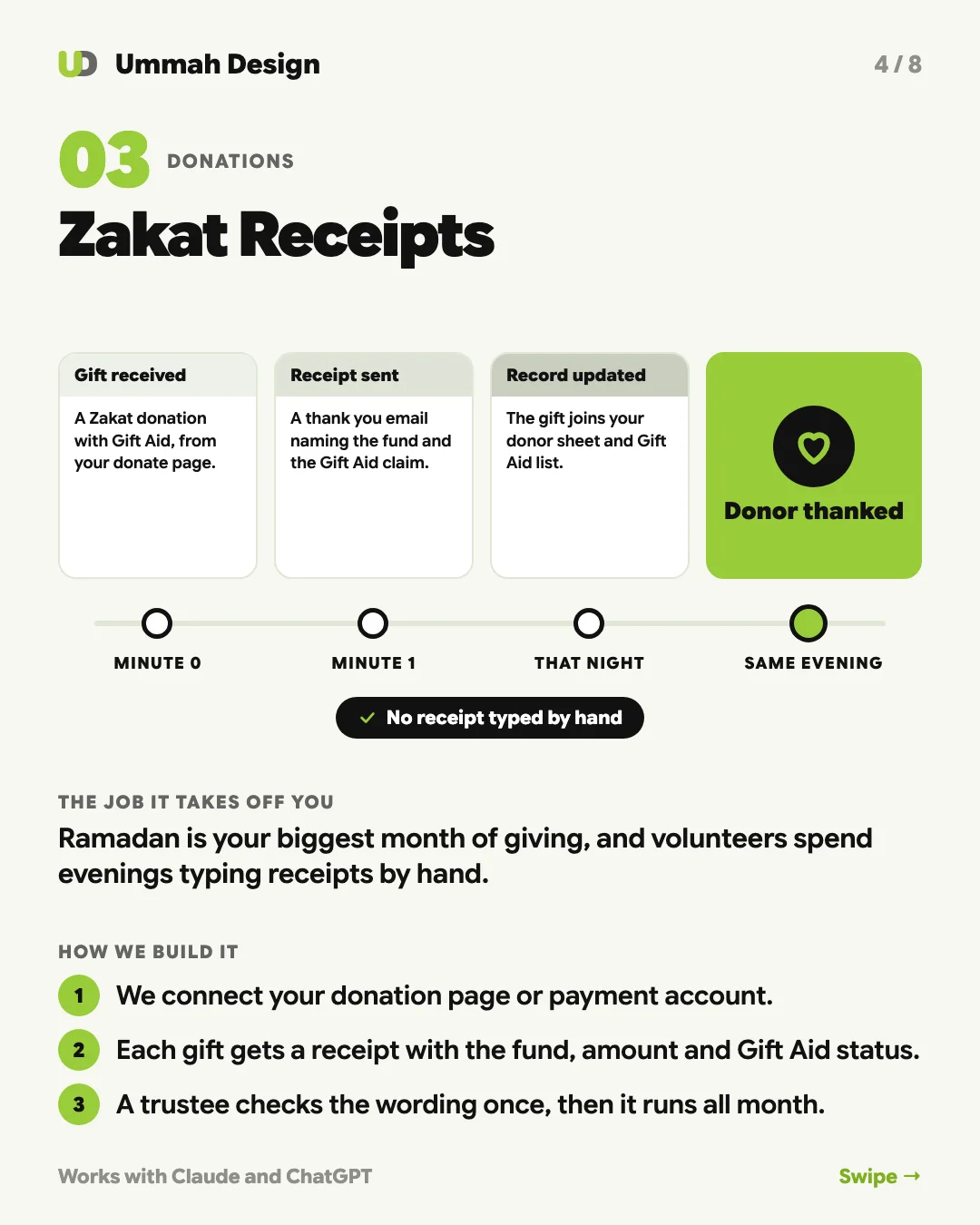
One point we always insist on: a trustee reads and approves the receipt wording before it goes live. After that it runs all month. Keeping Zakat clearly separated from general donations is a job in itself, and we have written more about running mosque and charity fundraising through the month.
How do you build a Ramadan staff rota that people can follow?
In most businesses the Ramadan rota ends up in a group chat. Someone asks to swap, three people reply, and by Thursday nobody is sure who is closing on Friday.
A rota automation starts with availability. Staff fill in a short form saying which days and hours they can work, including whether they want to be home for iftar on certain nights. A draft rota is built around your busiest hours, the iftar rush and the late shifts, and any gaps are flagged before the week starts. You look at it, swap a shift if you want, and approve it. Each person then gets their own shifts on WhatsApp or by email.
The person in charge still decides. The automation does the fiddly part: matching hours to availability and spotting the Friday night that is one person short.
How do you avoid running out of stock in the last ten nights?
Dates, samosas, sweets, gift boxes, prayer mats. Whatever your Ramadan best sellers are, they tend to sell out in the last ten nights, which is exactly when suppliers are busiest too. The first warning is usually an empty shelf.
A stock alert watches your till or online shop for the items you care about. When one drops below the level you set, you get a message. A supplier order is drafted from what you normally buy, and you check it and send it. If you kept sales records from last Ramadan, they can help you set those levels sensibly, rather than guessing.
Nothing is ordered without you. The point is to be told early enough that you have a choice.
When should Eid offer emails go out?
Earlier than most businesses manage. Eid offers often go out late because they are written late, after a long day of fasting, the night before people want to order. By then many customers have already bought elsewhere.
The better approach is to write the emails before Ramadan starts and schedule them across the last ten days. A simple pattern that works for shops, bakeries and restaurants alike:
- Ten days to go: a first look at your Eid range or menu, with the order deadline.
- Five days to go: a reminder, sent only to people who have not ordered yet.
- Two days to go: the last call, with the cut-off and the collection or delivery times.
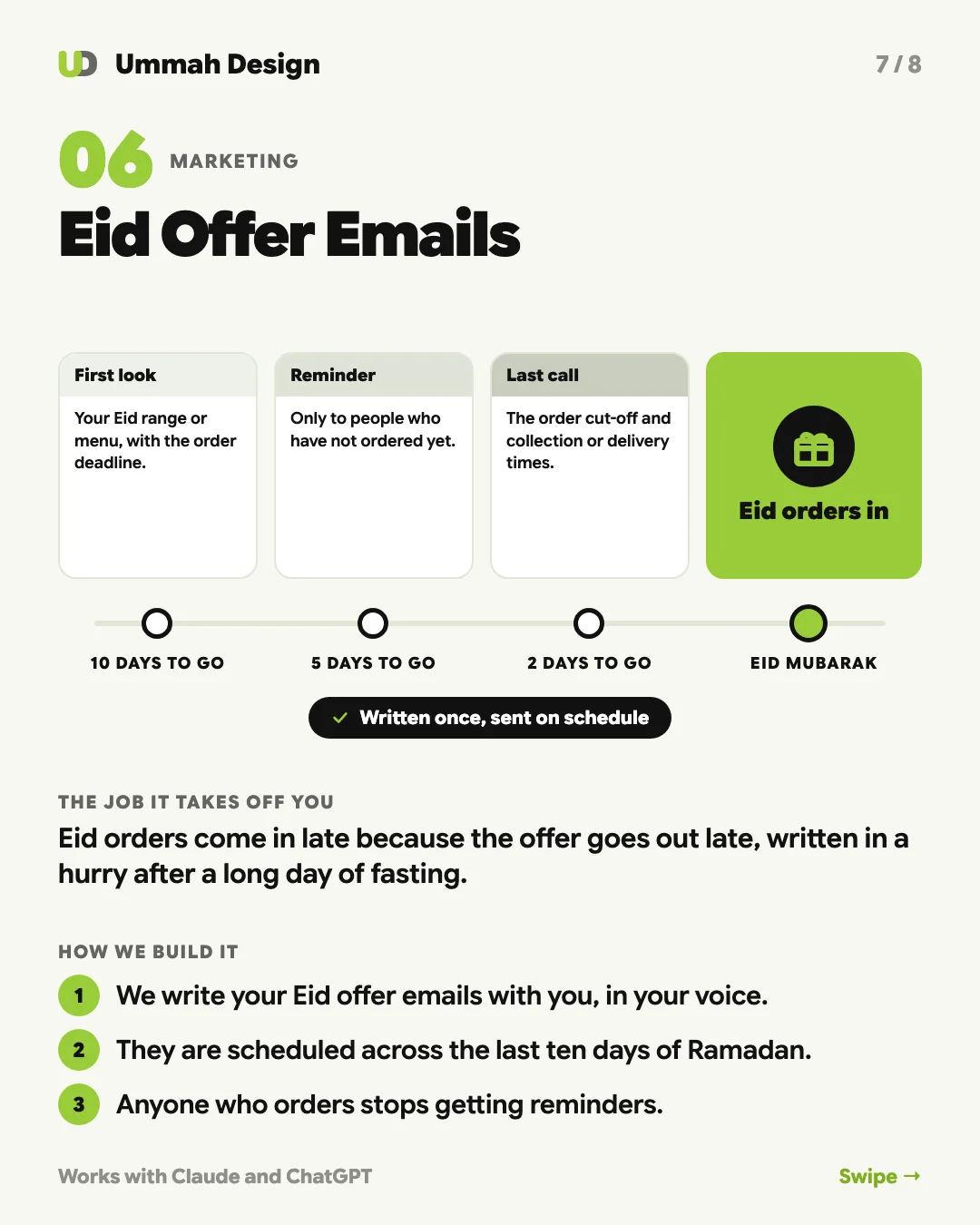
We write these with you, in your voice. Anyone who orders stops getting reminders, which saves your regular customers from feeling chased. Eid al-Fitr is expected around 10 March 2027, so the last ten days of Ramadan fall in early March.
Which of these should you start with?
Start with the job that hurt most last year. If the phone drowned you, start with pre-orders. If donors complained about late receipts, start there. If you ran out of stock on the 27th night, start with alerts.
A rough guide by type of business:
- Restaurants, takeaways and caterers: iftar pre-orders, Ramadan hours, staff rota.
- Shops and online stores: stock alerts, Eid offer emails, Ramadan hours.
- Charities and mosques: Zakat and donation receipts, then volunteer rota.
Two well-built automations that run all month are worth more than six half-finished ones. You can see more examples of what we build on our AI automation page.
Frequently asked questions
Is ten weeks really enough time?
For one to three of these jobs, yes, if you start in late November or early December. It leaves time to test in January. Trying all six at once in January is where things go wrong.
Will customers know they are talking to an automation?
They should. We make it clear when a reply is automatic, and anything unusual is passed to a person with a note.
Does anything go out without us checking it?
Routine confirmations and receipts run once you have approved the wording. Anything that commits you to something new, like a supplier order or a rota, waits for your OK.
What happens after Eid?
Hours switch back by themselves, Ramadan forms close on the date you set, and everything is ready to switch on again next year.
Want this ready before Ramadan?
We build these for you and test them before the month starts. If you would like to talk through which ones fit your business, book a free 30-minute call.