

You can run an orphan sponsorship programme online without putting a single child's photo, surname or village on the internet. That's the heart of orphan sponsorship safeguarding. Sponsors choose a child, pay monthly by card and see every payment, while the child's real details stay with your caseworkers. The payments are the easy part. The harder part is deciding what the public sees, how you record consent, and being honest about which kind of sponsorship you're actually offering.
This guide is for UK Muslim charities and mosques that already support orphans, here or overseas, and want to move sponsorship off paper forms and standing orders and onto their website.
Why orphan sponsorship suits a website
Caring for an orphan has a special place for Muslim donors. The Prophet (peace be upon him) said that he and the one who looks after an orphan will be in Paradise like this, and pointed with his index and middle fingers. People want to sponsor. What puts them off is the admin.
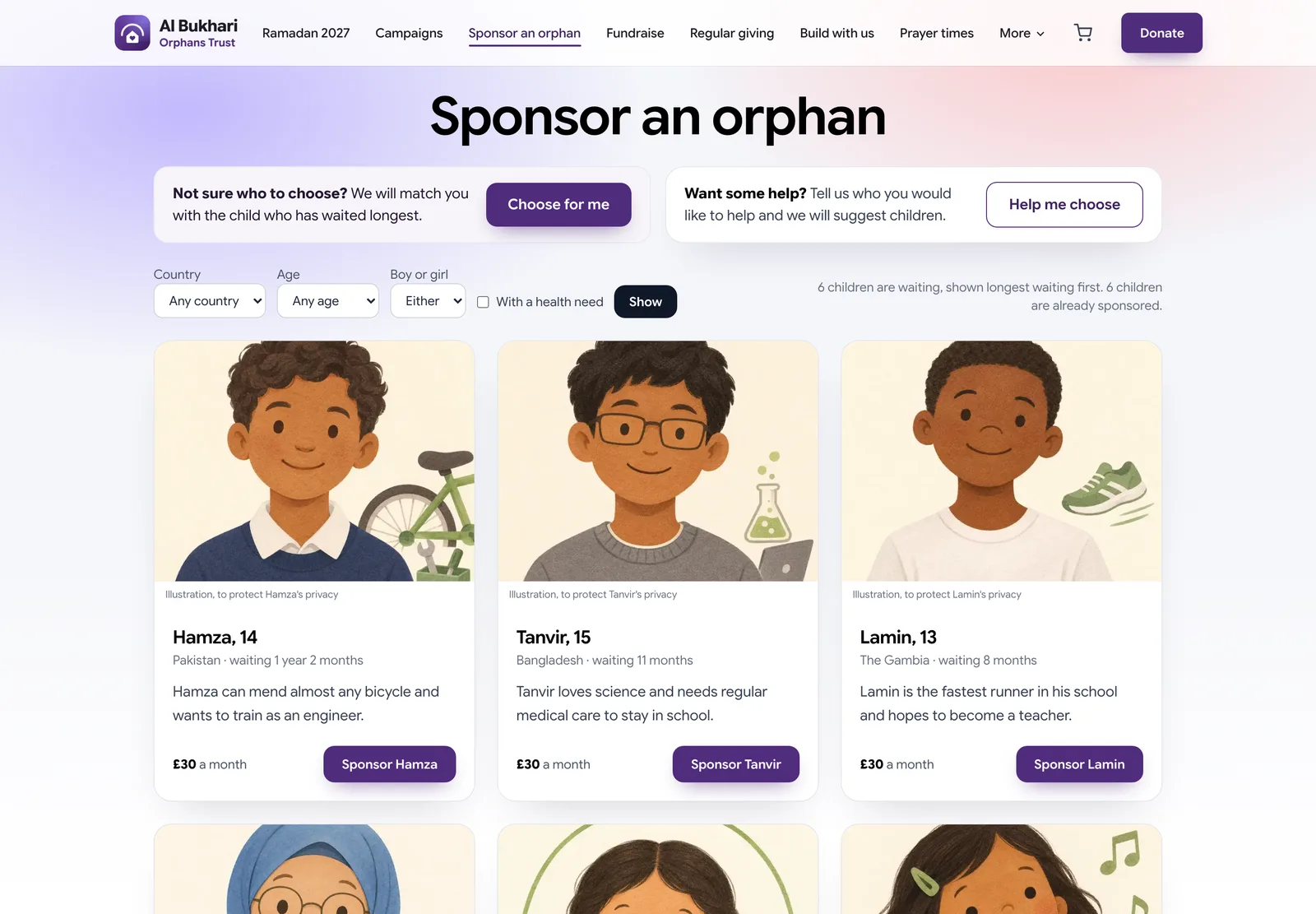
A sponsorship page lets someone choose a child at eleven at night after Taraweeh, set up a monthly payment in a couple of minutes and get on with their life. For your team it means fewer standing order forms to chase and a proper record of who sponsors whom. It also means anyone in the world can see that page, which is why privacy has to come before anything else.
Orphan sponsorship safeguarding: what the public should never see
Photos of vulnerable children travel. They get screenshotted and passed around WhatsApp groups long after the child has left your programme. A photo plus a first name plus a village is often enough for a determined person to find a child. So the rule we'd suggest is simple: the public page shows enough to connect with a child and nothing that could locate them.
This is part of a duty trustees already have. The Charity Commission's guidance on safeguarding and protecting people for charities and trustees says you must take reasonable steps to protect from harm people who come into contact with your charity, and that includes the children you sponsor.
In our system the public sees a first name, age, country, a short and a longer bio, and what sponsorship pays for. That's it. Instead of a photo, each child has an illustration drawn from a description your staff write (age, clothes, a favourite thing), labelled "Illustration, to protect Amina's privacy". Sponsors still get a face to connect with. The child keeps their privacy.
Consent comes first
A child can't be listed until a guardian's consent is recorded. If the guardian withdraws consent, the child comes off the website straight away. It's worth deciding now who in your team takes that call and how quickly they act on it.
The case file stays private
The full record (full name, date of birth, guardian, health and the child's story) sits in an encrypted case file that only caseworkers can open, and every time someone opens it, that's logged. Child pages are also kept out of Google, so a search for a child's name won't bring up your page.
One-to-one, shared or pooled: which child sponsorship model do you run?
There are three common ways to run sponsorship, and our system supports all of them:
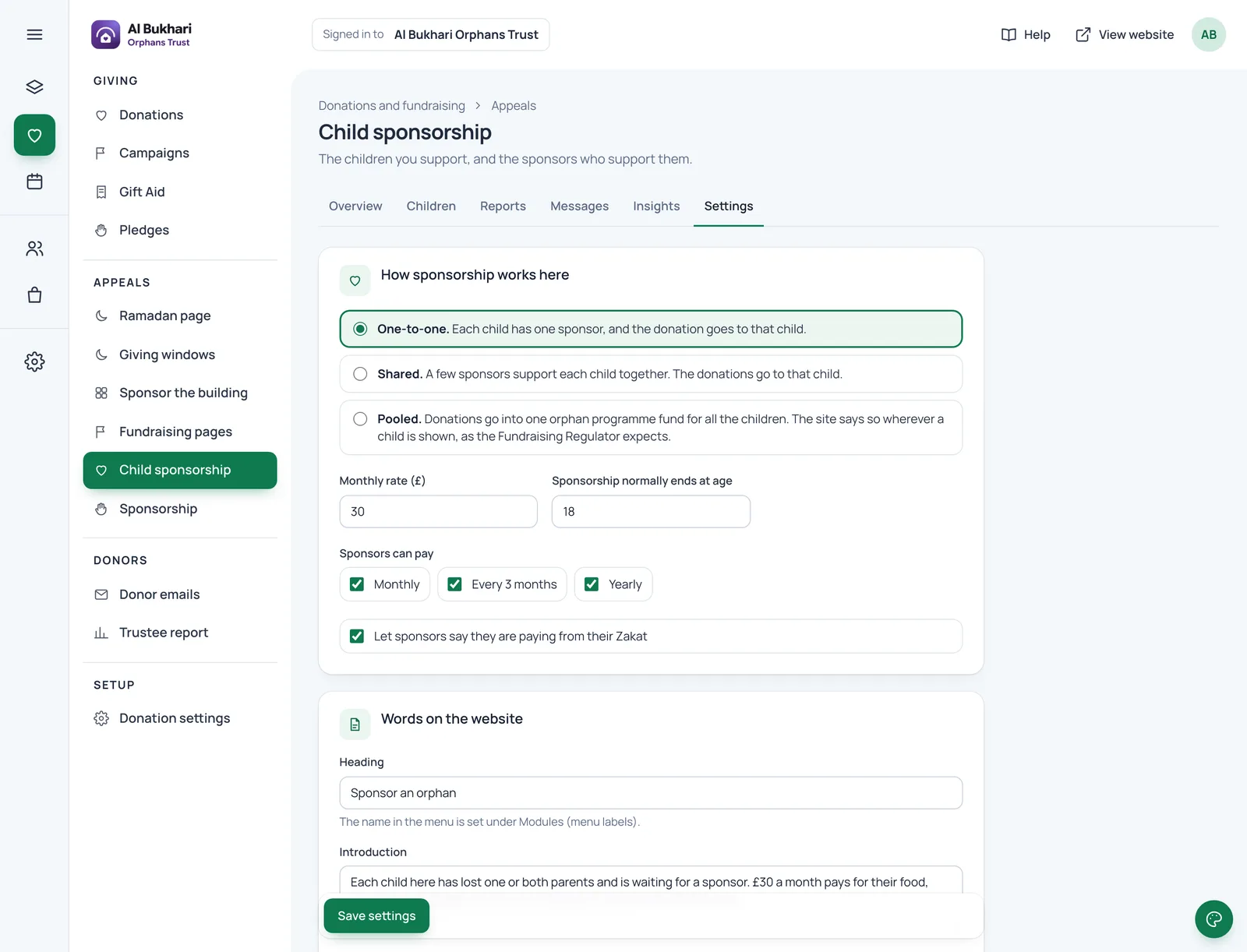
- One-to-one: one sponsor, one child.
- Shared: a few sponsors each support the same child, which helps when the monthly cost is more than one family can manage.
- Pooled: donations go into one programme fund that supports all the children, and the website says so plainly.
Being clear about this matters more than it used to. In April 2025 the Fundraising Regulator published guidance for charities using child sponsorship, updated in November 2025 to line up with the 2025 Code of Fundraising Practice. It describes direct sponsorship (one to one or many to one), community sponsorship, where the money goes to a wider project, and hybrid schemes that do both. It says charities must make clear from the outset who will benefit from the donation, that donors should see the type of sponsorship before or alongside the donate button, and that promotional material should link to an FAQ page explaining it. If you offer a direct link to a child, you must be able to evidence it.
A pooled programme sits closer to what the guidance calls community sponsorship. Nothing wrong with that, as long as you don't market it as "sponsor this child" and leave the sponsor thinking their money goes to one person. Read the guidance yourself before you launch. It's practical and worth the half hour.
What sponsors expect once they've signed up
Sponsors want flexibility. In our system they can take one child or several, and pay monthly, every three months or yearly by card. They can add a top-up, add Gift Aid, mark the payment as coming from their Zakat, and add a dedication, for example in memory of a parent. If you take Zakat, our post on keeping a separate Zakat fund shows how to report it on its own.
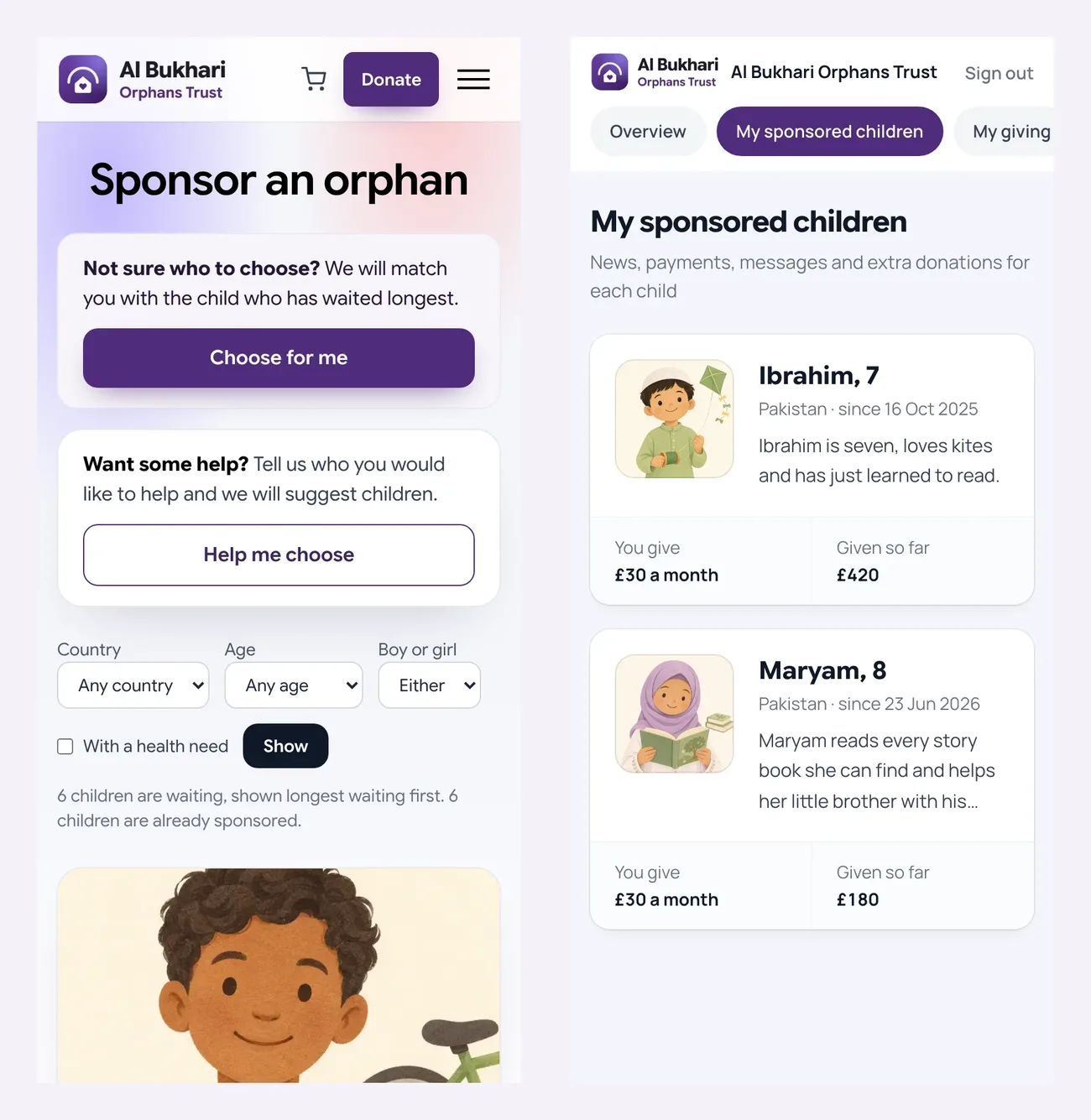
They also want to see where things stand without ringing the office. Each sponsor has a "My sponsored children" section in their donor dashboard showing every payment. They can change their card there, or stop sponsoring one child without cancelling the others. Sponsors sit in the same donor records as everyone else who gives to you.
And they'll want to hear how the child is doing. Plan who writes those updates and how often, and keep them as careful as the listing itself. A cheerful update that names a school undoes all the work you did on the public page.
Setting up a safe orphan sponsorship programme: a checklist
- Decide the model (one-to-one, shared or pooled) and write it down in one sentence a sponsor would understand.
- Write your sponsorship FAQ before launch: the model, what the monthly amount pays for, and what happens if a child leaves the programme.
- Agree how you'll handle a child leaving. The regulator's guidance says the sponsor must be told, you may offer another child, and if they decline you stop taking their money.
- Get each guardian's consent and record it. Decide who can withdraw it and how fast you act.
- Name your caseworkers. Nobody else needs access to case files.
- Write bios that tell a story without identifying anyone. No school names, villages or relatives' full names.
- Write a short description of each child for the illustration instead of uploading photos.
- Brief whoever answers the phone, so they can explain the model the same way the website does.
Where our system fits
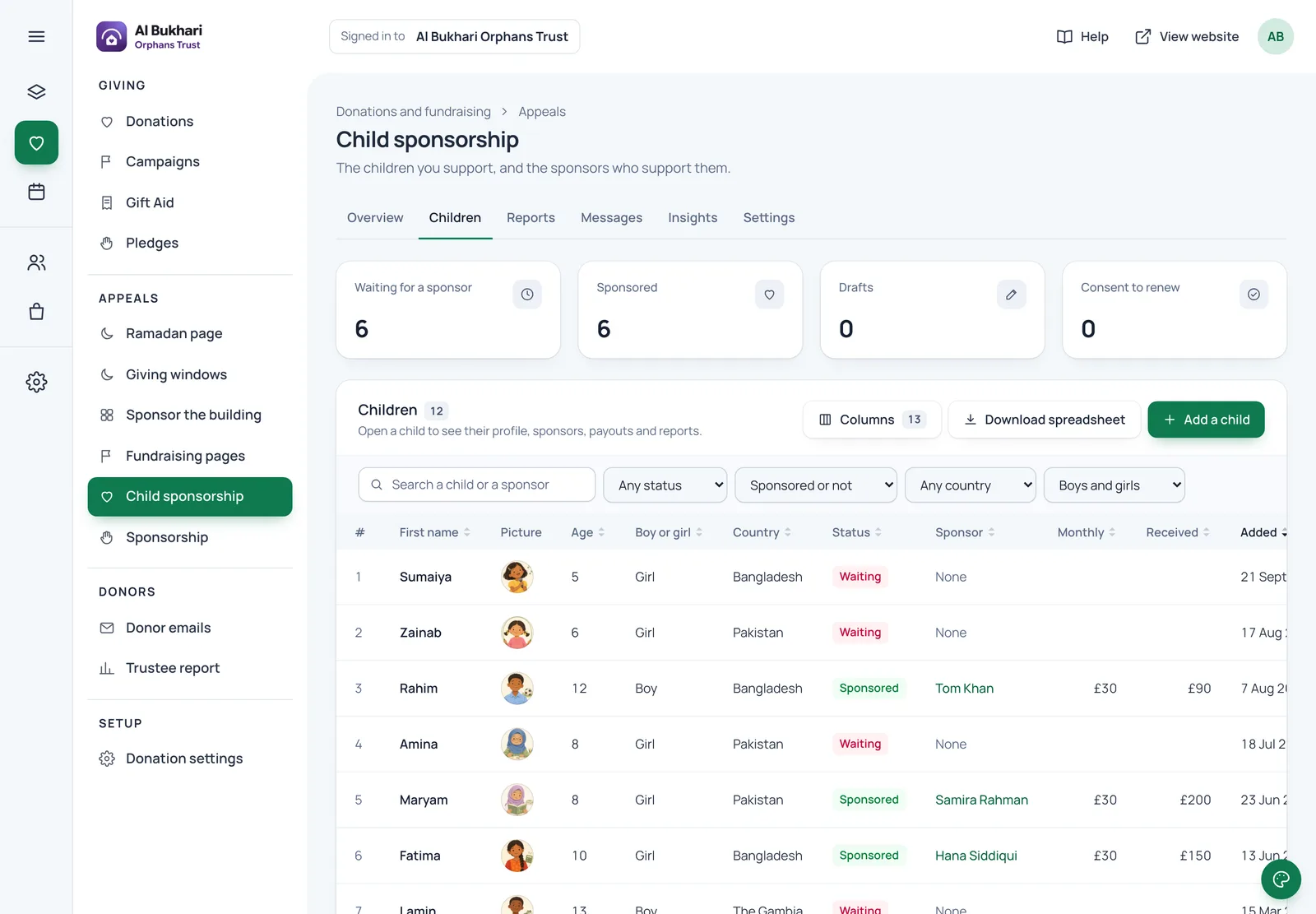
Child sponsorship is one part of our fundraising system for charities and mosques. Staff add a child with a first name, year of birth, country, bios and what sponsorship pays for. The website shows the children who have been waiting longest first, and there's a "Choose for me" button for sponsors who don't want to pick. For every screen, from the sponsor's sign-up to the staff side, see our tour of the orphan sponsorship web app.
Payments go straight into your charity's own Stripe account. We never hold the money and we don't take a percentage. Gift Aid is collected online or on paper, and the HMRC claim file is built for you, as our guide to Gift Aid for mosques and charities explains. The same system runs one-off and monthly donations, your CRM and donor dashboards, and supporter fundraising pages, which we cover in our guide to peer-to-peer fundraising for charities and mosques.
Frequently asked questions
What does safeguarding mean for an orphan sponsorship programme?
It means the public page shows enough to connect with a child and nothing that could locate them: a first name, age and country, but no photo, surname, school or village. Guardian consent is recorded before a child is listed, and the full case file stays with your caseworkers.
Can we show photos if the guardian agrees?
Consent is needed, but it doesn't make a photo safe. Once a picture is online you can't take it back. That's why our public pages use an illustration drawn from a description and never a photo.
Can sponsors pay from their Zakat?
Whether a particular programme is Zakat-eligible is a question for your own scholars and Zakat policy. The system lets a sponsor mark their payment as coming from Zakat, so your team knows which money it is.
What's the difference between shared and pooled?
In shared sponsorship a few named sponsors support one particular child. In pooled sponsorship everyone's donation goes into one fund for the whole programme. Tell sponsors which one they're joining before they pay.
Will the children's pages show up on Google?
No. Child pages are set so search engines don't index them. Sponsors find children through your website, not through a search for a name.
If you're planning to open or move a sponsorship programme before Ramadan, we'd be glad to walk you through it with real screens rather than slides. Book a demo of the charity and mosque fundraising system and bring your questions about consent and privacy with you.